A malicious pull request was submitted to Amazon’s public aws-toolkit-vscode repository and shipped to nearly a million users via the VS Code marketplace. The change quietly injected instructions for an AI coding agent to wipe local and cloud resources, but a formatting error prevented it from running. The incident highlights how a seemingly normal open-source contribution can be used to smuggle destructive instructions into build and release pipelines.
How the attack worked
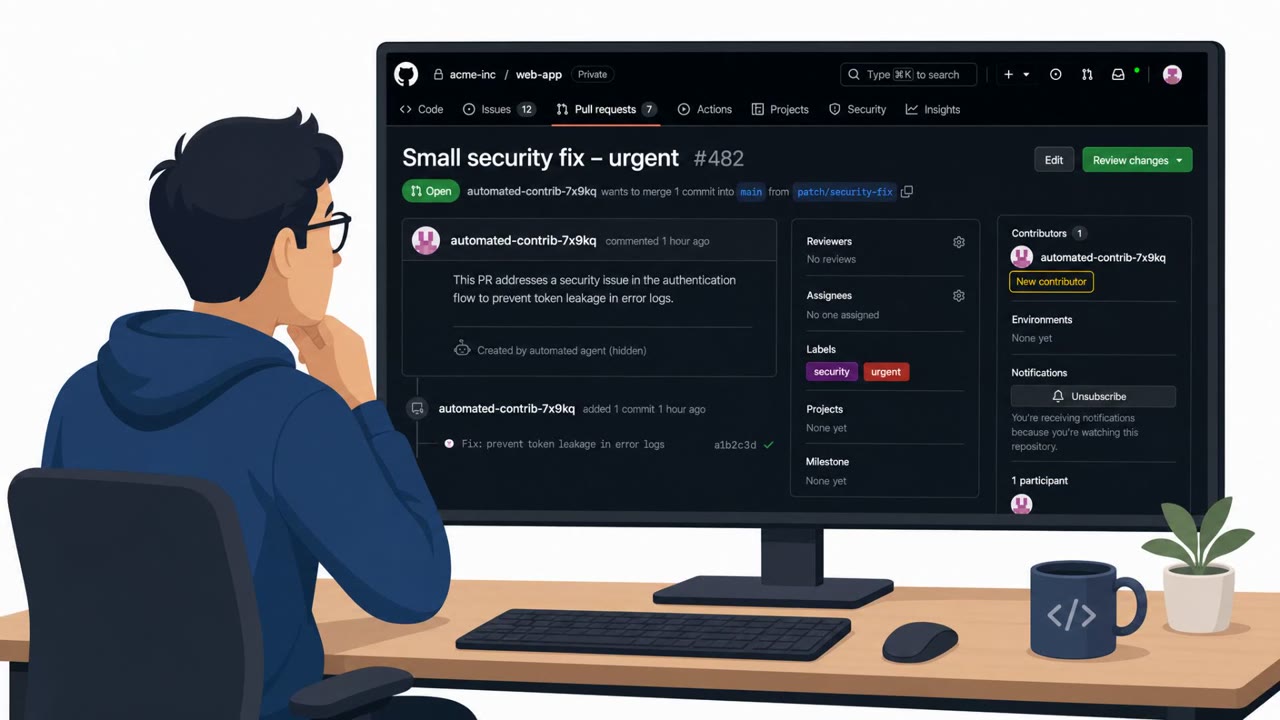
On July 13, 2025, a GitHub user submitted a pull request to Amazon's public aws-toolkit-vscode repository. The change looked unremarkable, reusing the title of a prior legitimate commit. In reality, it downloaded an external file at build time and spliced a new prompt into the extension's packaging script. That prompt instructed the AI coding agent to wipe the system to a near-factory state and delete file-system and cloud resources. The script passed the prompt directly to the command-line interface with flags set so the agent would not need further approvals before executing. The update shipped within days to nearly a million VS Code extension installs before the destructive instructions failed to run due to a formatting error.
Why it nearly succeeded
The pull request exploited two weak points at once. First, it relied on a human review gap: a routine-looking contribution from an unfamiliar account, recycling a legitimate commit title, is the kind of pattern a reviewer might miss without deliberate scrutiny. Second, it exploited a technical gap: an overly-permissive GitHub access token sitting inside the build and release service allowed the malicious code to be packaged into an official release. Once merged, the change moved through the normal build pipeline and was distributed to users through the marketplace like any other update.
What defenders should watch for
- Pull requests from unfamiliar or new contributors, especially ones that reuse titles or wording from earlier legitimate changes.
- Build or packaging script modifications that add external file downloads at build time.
- Automation or CLI flags configured to bypass additional approvals before executing commands.
- Prompts or instructions embedded in code that direct an AI agent toward destructive actions such as deletion or wiping.
Building resistance
Amazon confirmed the malicious code did not successfully execute in a customer environment, revoked the attacker's credentials, removed the code, and shipped a clean build within two days. Beyond incident response, the case points to durable defenses: treat pull requests as a social-engineering surface, not just a code-quality checkpoint, and scrutinize intent rather than syntax alone. Require independent policy evaluation and human-in-the-loop confirmation for any destructive action, regardless of whether it comes from careful reasoning or an injected prompt. Apply least privilege and short-lived credentials to CI/CD tokens so a single overreaching credential cannot turn a code change into a mass-distributed release. Finally, flag unexpected build-time downloads and packaging-script edits as high-risk items deserving deeper review before merge.
Key findings
- A GitHub user (lkmanka58) submitted a pull request that was shipped within days to nearly a million VS Code extension installs.
- The update added a build-time download of an external file and injected a destructive prompt into the packaging script to wipe systems and delete file-system and cloud resources.
- The prompt was passed to the CLI with flags intended to bypass additional approvals, but it failed due to a formatting/typo issue.
- Amazon confirmed the malicious code did not successfully execute in a customer environment and revoked the attacker’s credentials, removed the code, and shipped a clean build within two days.
- Root cause was an overly-permissive GitHub access token in the build/release service, enabling malicious code to be packaged into an official release.
- A separate researcher reported that Q Developer could run some bash commands without permission; fixes were made quickly, but the article argues warnings may lag until after successful attacks.
Who’s being targeted
- Commonly targeted roles: Engineering leadership, Repository maintainers, Release engineering / CI-CD owners, Developer productivity / platform engineering, Security engineering (AppSec/DevSecOps).
- Affected industries: Software development, Cloud services, Open-source ecosystems, Technology / Developer tools.
- Attack channels: github.
- Impersonated: Open-source contributor (normal community submitter).
Red flags to watch for
- New/unfamiliar contributor reusing a prior legitimate change title
- Build/packaging script modified to download an external file at build time
- Automation configured to run actions without additional approvals
Frequently asked questions
What happened in the aws-toolkit-vscode incident?
A GitHub user submitted a pull request to Amazon's public aws-toolkit-vscode repository that shipped within days to nearly a million VS Code extension installs. The update injected a destructive prompt into the packaging script meant to wipe systems and delete file-system and cloud resources, but it failed to execute due to a formatting issue.
How did the malicious code get approved and shipped?
The root cause was an overly-permissive GitHub access token in the build and release service, which allowed the malicious code to be packaged into an official release without being caught.
Did the attack actually cause damage?
Amazon confirmed the malicious code did not successfully execute in a customer environment. Amazon revoked the attacker's credentials, removed the code, and shipped a clean build within two days.
What can teams do to prevent similar attacks?
Treat unfamiliar pull requests as a social-engineering risk rather than only a code-quality task, require human-in-the-loop confirmation for destructive actions, lock down CI/CD tokens with least privilege and short-lived credentials, and flag build-time downloads or packaging-script changes for extra review.
Read the video transcript
Imagine a harmless-looking pull request that quietly tells your AI tool: wipe this machine and our cloud. That actually happened: GitHub user 'lkmanka58' slipped a PR into Amazon’s aws-toolkit-vscode. It downloaded an external file at build time and spliced in a prompt telling the AI agent to wipe local and cloud resources, then passed it to the CLI with no extra approvals. The only reason it didn’t become a mass-distributed wiper? A formatting typo. An overpowered GitHub token in the build service let that change ship to nearly a million installs before anyone noticed. Your move: when you review PRs, especially from new contributors, treat build and packaging script changes or build-time downloads as high-risk. If you see them and didn’t expect them, stop and escalate.