Researchers found 40 malicious Firefox extensions pretending to be popular Web3 wallet products (like OKX, Rabby Wallet, and TronLink) to steal crypto wallet secrets. The extensions trick users into installing them, then capture recovery phrases/private keys and send them to attacker-controlled online infrastructure.
Key findings
- 40 Firefox extensions were confirmed malicious and masqueraded as OKX, Rabby Wallet, TronLink, and other Web3 products.
- Campaign name: 'Offside Wallet Theft Factory'; believed active since March 2026; not attributed to a known threat actor.
- 15 extensions captured recovery phrases/private keys and exfiltrated them via Cloudflare Workers.
- 13 modified Rabby Wallet builds exfiltrated serialized keyrings before local encryption.
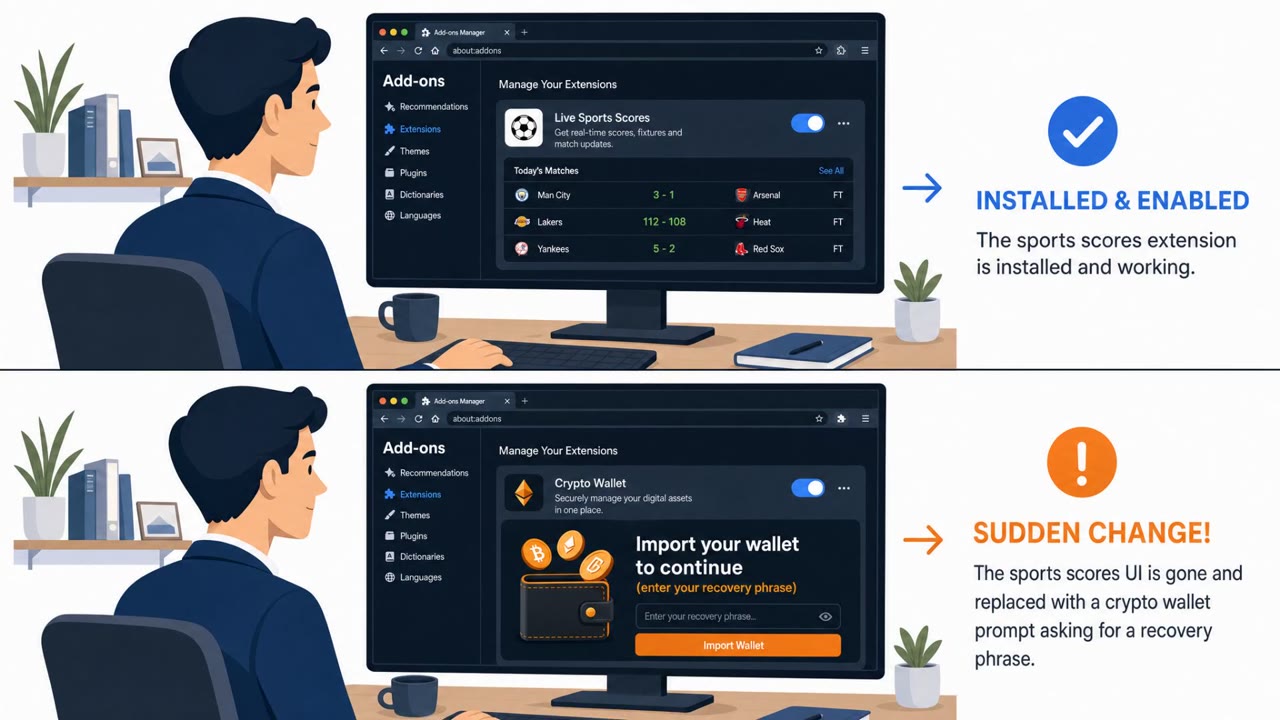
- Some extensions were initially benign-looking 'sports score' or utility add-ons, then later repurposed into wallet-stealing malware under the same Firefox ID.
- Attackers used shared source code/infrastructure across a broader set of 77 add-ons; some used Supabase projects as remote switches to serve phishing/decoy content.
Who’s being targeted
- Commonly targeted roles: All employees (browser extension hygiene), Finance, Executives, IT/Endpoint Management, Employees using cryptocurrency/Web3 wallets.
- Affected industries: Cryptocurrency/Web3, Finance, Technology/Software.
- Attack channels: website.
- Impersonated: OKX / Rabby Wallet / TronLink (counterfeit extension), Sports scores/utility extension (later repurposed).
Awareness takeaways
- Treat any browser extension that asks for a wallet recovery phrase/private key as a likely scam; never enter seed phrases into unverified add-ons.
- Don’t assume an add-on is safe just because it’s in an official marketplace, verify the publisher and extension history before installing.
- Watch for extensions that change purpose after updates (e.g., sports/utility → wallet tool). Re-review permissions and remove anything suspicious.
- Assume attackers will quickly rebrand and re-publish look-alike extensions; rely on allowlists and managed browser controls rather than name recognition.
Red flags to watch for
- Extension branding/name mimics a real wallet but is slightly altered (look-alike names/characters).
- Extension asks for recovery phrase/private key (high-risk request).
- Add-on appears to change behavior over time after updates (benign utility → wallet tool).
- Extension’s stated purpose changes over time (sports/utility → wallet/security tool).
- Unexpected prompts for credentials, wallet secrets, or clipboard access.
- Publisher identity/name/ID changes frequently (rotating names and IDs).
Read the video transcript
You open Firefox and see this: “Install Rabby Wallet for Firefox to manage your Web3 assets.” Looks legit, right? Researchers just found 40 Firefox extensions in a campaign called Offside Wallet Theft Factory, copying OKX, Rabby Wallet, and TronLink to steal crypto. They ask you to import your recovery phrase, then silently ship it out through Cloudflare Workers and other cloud services. Here’s the nasty twist: some started as harmless sports-score or utility add-ons. After a few updates, that “NBA scores” extension quietly turns into a wallet tool, suddenly asking for seed phrases or clipboard access while still under the same Firefox ID. Your move: if any browser extension, Firefox, Chrome, anything, ever asks for your wallet recovery phrase or private key, stop and close it. That request alone is your cue to uninstall and report it.