Revolut says a third party posing as a government agency tricked the company into disclosing some customers’ personal and financial data. The attacker used an email address on a legitimate government agency domain, causing the request to be treated as a real legal inquiry. Revolut says customer funds and internal systems were not affected, but impacted users are being notified.
What Happened
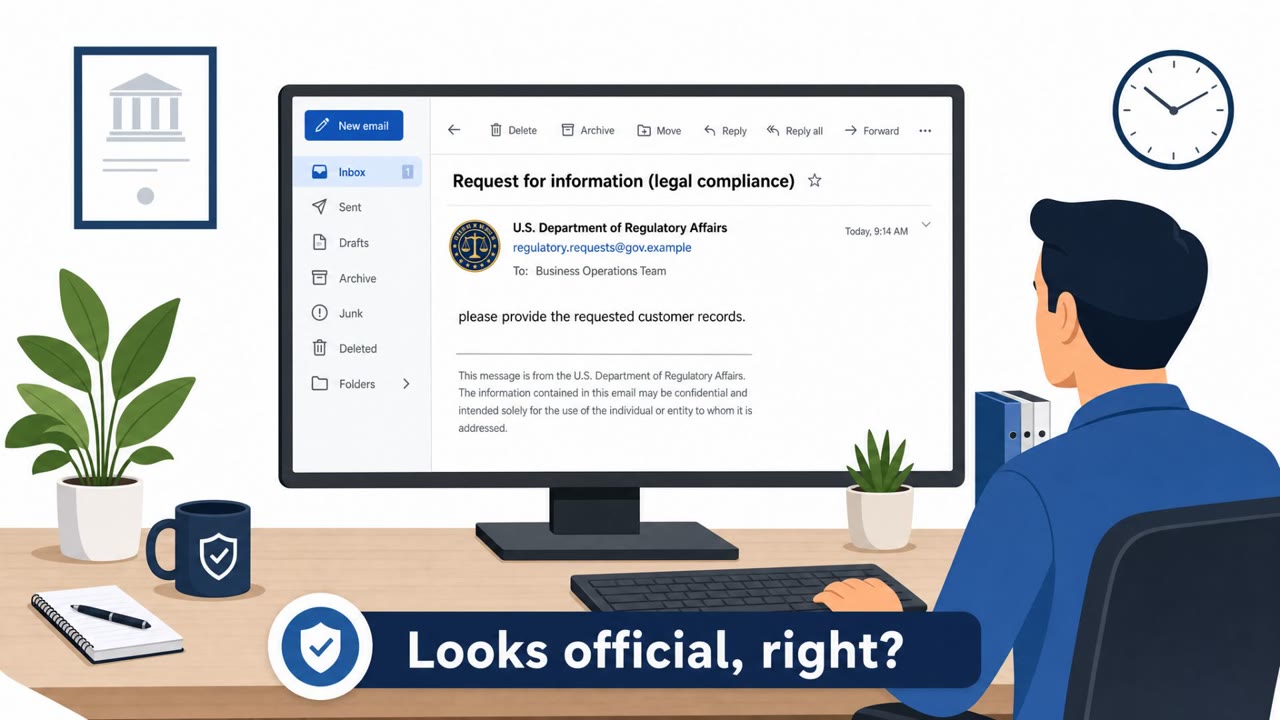
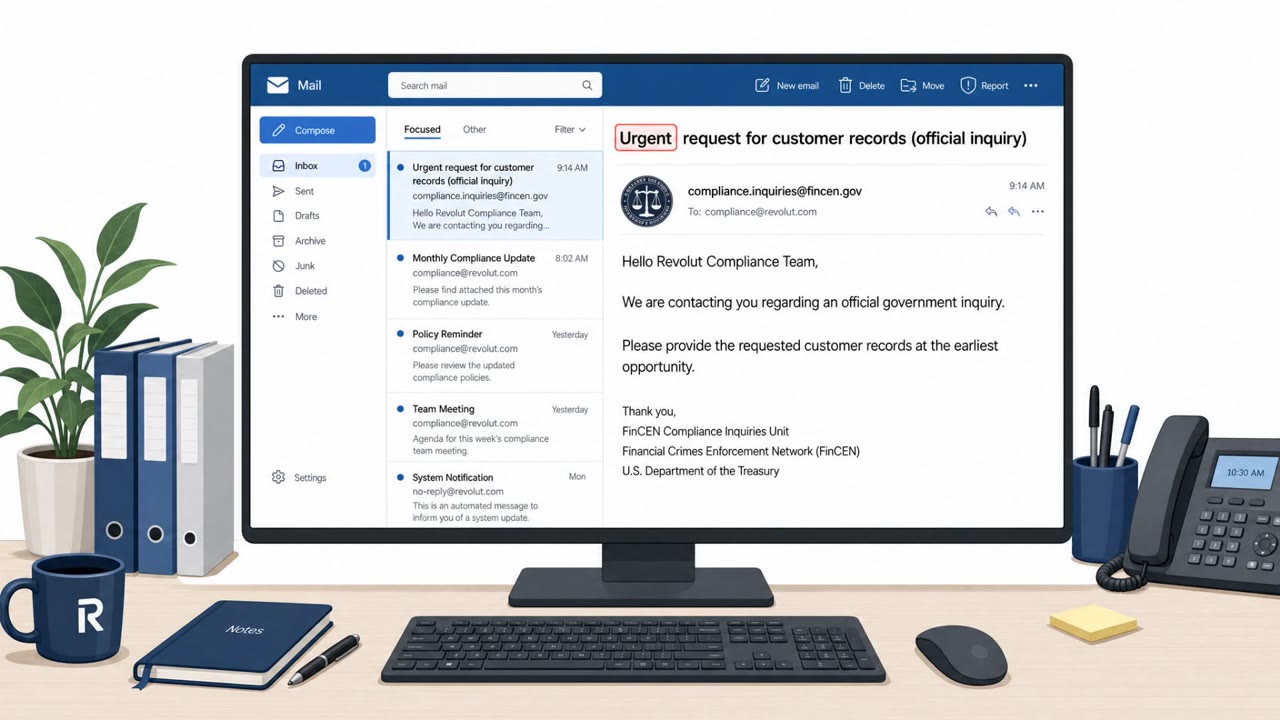
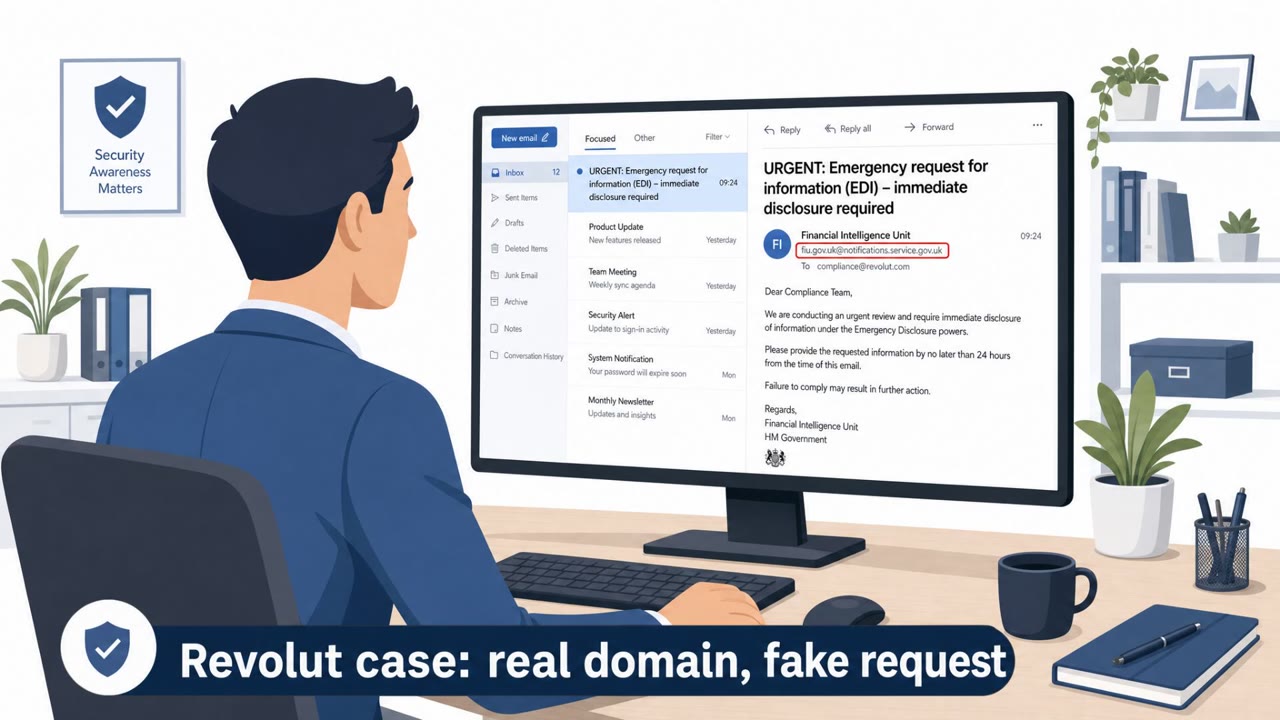
Revolut disclosed that a third party impersonating a government agency tricked the company into disclosing personal and financial information belonging to a subset of customers. The attacker used an email address on a legitimate government agency domain to submit what appeared to be a formal legal inquiry. Because the request carried valid technical domain credentials, it was treated as an authentic agency inquiry rather than flagged as suspicious.
How the Attack Worked
The scenario followed a common pattern for legal/law-enforcement pretext attacks:
- The attacker impersonated a government agency using its actual email domain
- The request was framed as an official inquiry tied to an ongoing investigation
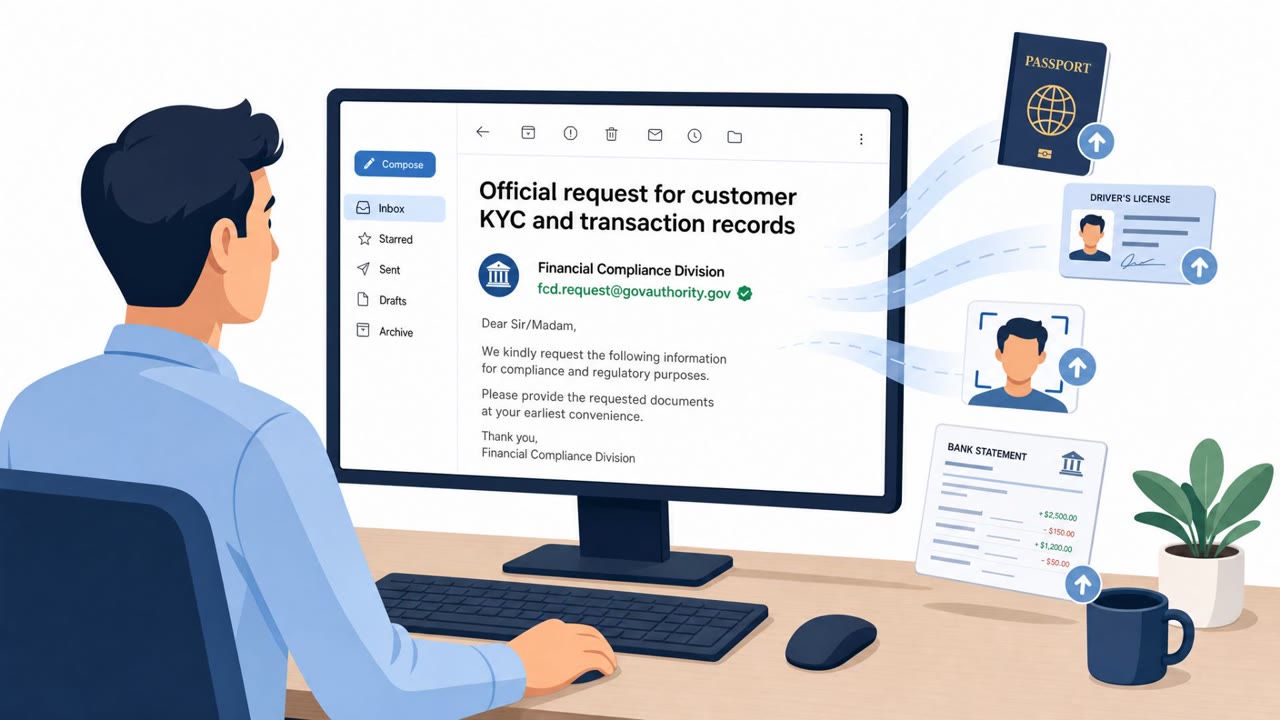
- The email asked for broad categories of customer information, including identity documents, verification selfies, and full transaction history
- Recipients relied on the domain itself as proof of legitimacy rather than an independent verification step
Exposed data reportedly included names, addresses, phone numbers, dates of birth, occupation, copies of driver's licenses and passports, and verification selfies, along with financial details such as IBANs, account statements, withdrawal records, and full transaction history including Bitcoin activity.
Why It Succeeded
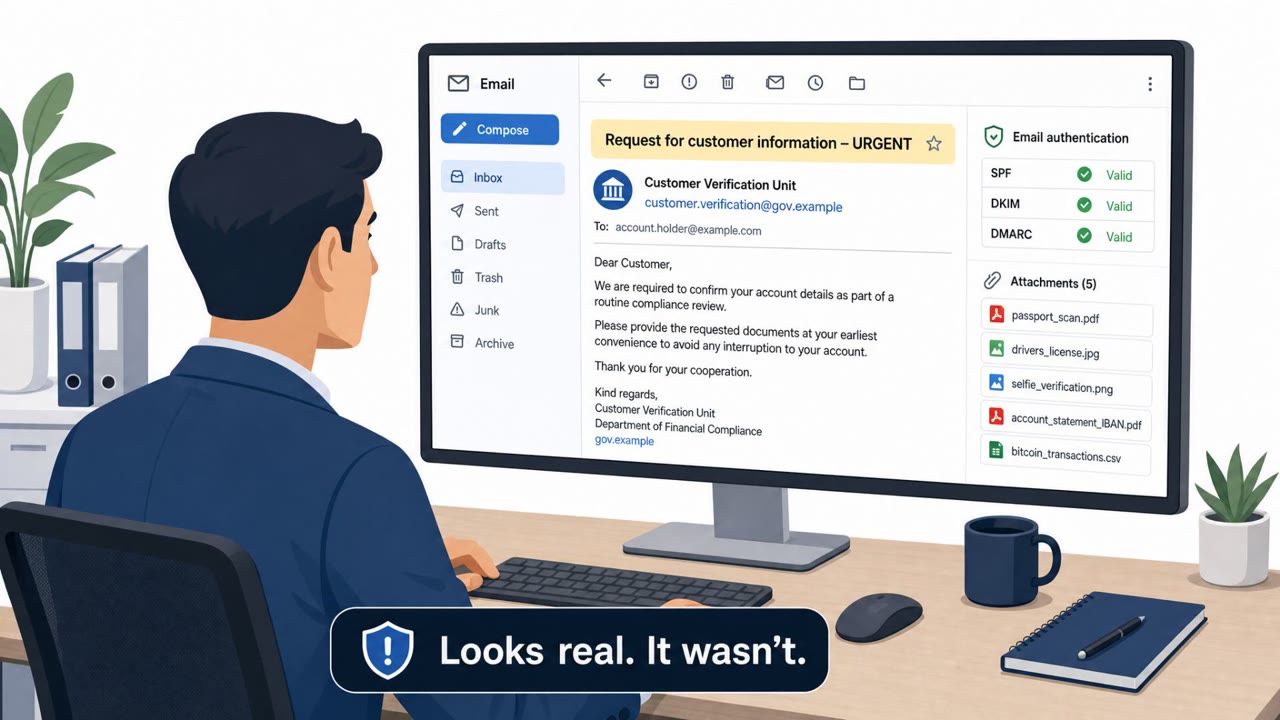
This incident illustrates why domain-based trust is not sufficient on its own. Because the email originated from a legitimate government agency domain and carried valid technical credentials, it passed the checks that teams often use to judge authenticity. Email as a single validation channel, without a callback to a known number or confirmation through an official portal, left little room to catch the fraudulent nature of the request. The unusual breadth of the ask, spanning identity documents and complete transaction histories, is itself a red flag that can be missed when a request otherwise looks technically sound.
What to Watch For
Teams that handle legal, compliance, and data requests should watch for:
- Requests for highly sensitive identity artifacts (ID copies, selfies) bundled with financial history
- Urgency or pressure language pushing for fast compliance
- Reliance on email alone, with no option to verify through a known contact or established portal
- Requests that reference an investigation without clear, verifiable case details
Building Resistance
Organizations can reduce exposure to this type of impersonation by treating emailed legal requests as high-risk by default and verifying them through an independent, trusted channel such as a known phone number or established point of contact. Limiting data disclosure to the minimum necessary, and applying added scrutiny when a request asks for full transaction history or identity documents, can also reduce the impact if a fraudulent request slips through initial review. Training legal, compliance, privacy, fraud, and customer support teams to recognize that a legitimate-looking domain does not guarantee a legitimate request is central to defending against this kind of social engineering.
Key findings
- A third party impersonated a government agency to obtain customer data.
- The attacker “utilized a legitimate government agency domain email” to submit fraudulent data requests.
- Exposed data reportedly included extensive PII (including ID documents and selfies) and financial history (including transaction history and Bitcoin transactions).
- The fraudulent request “carried valid technical domain credentials and was treated as an authentic agency inquiry.”
- Revolut says customer funds and Revolut systems were not affected; a subset of users was impacted.
Who’s being targeted
- Commonly targeted roles: Legal, Compliance, Privacy/Data Protection, Fraud Operations, Customer Support Operations, Information Security.
- Affected industries: Financial services / Fintech, Digital banking (neobank).
- Attack channels: email.
- Impersonated: Government agency (using a legitimate agency domain email).
Red flags to watch for
- Request relies on email as the only validation method (no independent callback/portal verification).
- Unusual breadth of requested data (IDs, selfies, full transaction history) for a single inquiry.
- Pressure/urgency framing to speed compliance with the request.
Frequently asked questions
How did attackers trick Revolut into disclosing customer data?
An unauthorized third party used a legitimate government agency domain email to submit fraudulent data requests, which carried valid technical domain credentials and was treated as an authentic agency inquiry.
What data was exposed in the Revolut impersonation incident?
Exposed data reportedly included PII such as ID documents and verification selfies, along with financial history including transaction records and Bitcoin transactions.
Were customer funds or Revolut systems affected?
Revolut says customer funds and internal systems were not affected, but a subset of users was impacted and is being notified.
Why did this impersonation attempt succeed despite using a real domain?
The request relied solely on email as validation, with no independent callback or portal verification, and the legitimate-looking domain caused the request to be treated as authentic.
Read the video transcript
Revolut got tricked by an email that looked like it was from a real government agency, and customer data walked out the door. Someone posed as a government agency, used a legitimate government-domain email, and asked for IDs, selfies, and full transaction history. The request carried valid technical credentials, so it was treated as a real legal inquiry. Here’s the trap: everyone trusts the domain and the legal tone, but no one stops to verify the request anywhere else. No callback to a known number, no check in an official portal, just email in, data out. Your move: any emailed ‘legal’ or ‘government’ data request? Pause. Independently verify it using a known phone number or official portal you look up yourself, before you send a single record.