Fake Maintenance Notices Power Real Estate Extortion

SOCRadar · High sophistication
Last updated October 27, 2026

An extortion operator compromised a Japanese real estate services company and used shared-hosting credentials to reach nearly 20 related websites. The attacker replaced public homepages with fake maintenance notices, placed ransom demands in admin panels, and prepared messages to pressure the victims’ customers and staff. The later PHP2Shell tooling was found on the attacker’s server but was not tied to the real estate intrusions.

Key findings

  • The operator used one compromised Japanese real estate site as a stepping stone to approximately 20 sites on shared hosting infrastructure.
  • Public homepages were replaced with a Japanese fake system-maintenance notice, while admin panels displayed a ransom demand and negotiation deadline.
  • The attacker used a stored SSH private key and a reused database password to access additional victim accounts.
  • A bulk-mailing script and a drafted public forum post were prepared to pressure the initial victim through its customers and public exposure.
  • Stolen customer data included 16,061 member records containing plaintext passwords, income, savings, contact details, and property-search information.
  • PHP2Shell files appeared on the staging server roughly ten days after the extortion wave, with no evidence that PHP2Shell enabled these intrusions.

Who’s being targeted

  • Commonly targeted roles: Website administrators, IT and security teams, Real estate company leadership, Customer support teams, Marketing and communications teams, Customers of affected real estate services.
  • Affected industries: Japanese real estate services, Property-buying businesses, Shared web-hosting customers, Taiwanese business services.
  • Attack channels: website, email.
  • Impersonated: The victim organization’s website or IT operations team, Extortion operator using the compromised organization and its website outage as leverage.

Awareness takeaways

  • Treat unexpected maintenance pages and contact instructions as untrusted until confirmed through a known company phone number, verified status page, or established support channel.
  • Do not respond directly to urgent extortion messages; preserve the message and escalate it immediately to the incident-response, legal, and executive teams.
  • Customers affected by a breach should be warned to use unique passwords and to be skeptical of highly personalized real estate or financial messages.
  • Shared hosting and reused credentials can turn one breach into many; require separate credentials and promptly rotate keys and passwords after any suspected compromise.

Red flags to watch for

  • An unexpected maintenance page replaces the normal company homepage.
  • The notice provides an unfamiliar contact address.
  • The organization has not announced maintenance through its usual verified channels.
  • Urgent language demanding an immediate reply.
  • Threats that disconnecting a website or ignoring messages will not help.
  • References to prior messages on an unverified channel such as LINE.
Try Mirage

Mirage safely runs attacks like this one against your own team, so you find out what happens before a real adversary does.

Get a demo
Read the video transcript

Your real estate company’s homepage suddenly says, ‘System maintenance notice.’ Here’s the trick: it’s the real website, but the notice is fake. It sends visitors to an unfamiliar contact address. Behind it, the admin panel shows a ransom countdown. One stolen SSH key and a reused database password helped spread this across roughly twenty sites. A drafted staff email even warned that ignoring LINE messages wouldn’t help. A real website can carry a fake instruction. Don’t use that address, call the company using a number you already know.

Similar attacks

Familiar Brands Fuel Account Takeover Scams

Familiar Brands Fuel Account Takeover Scams

TransUnion reports that criminals are using trusted brands and compromised customer information to trick people into sharing details, one-time passcodes, or access to their accounts. The scams exploit normal-looking security requests and can lead to account takeovers, redirected payments, and…

October 26, 2026
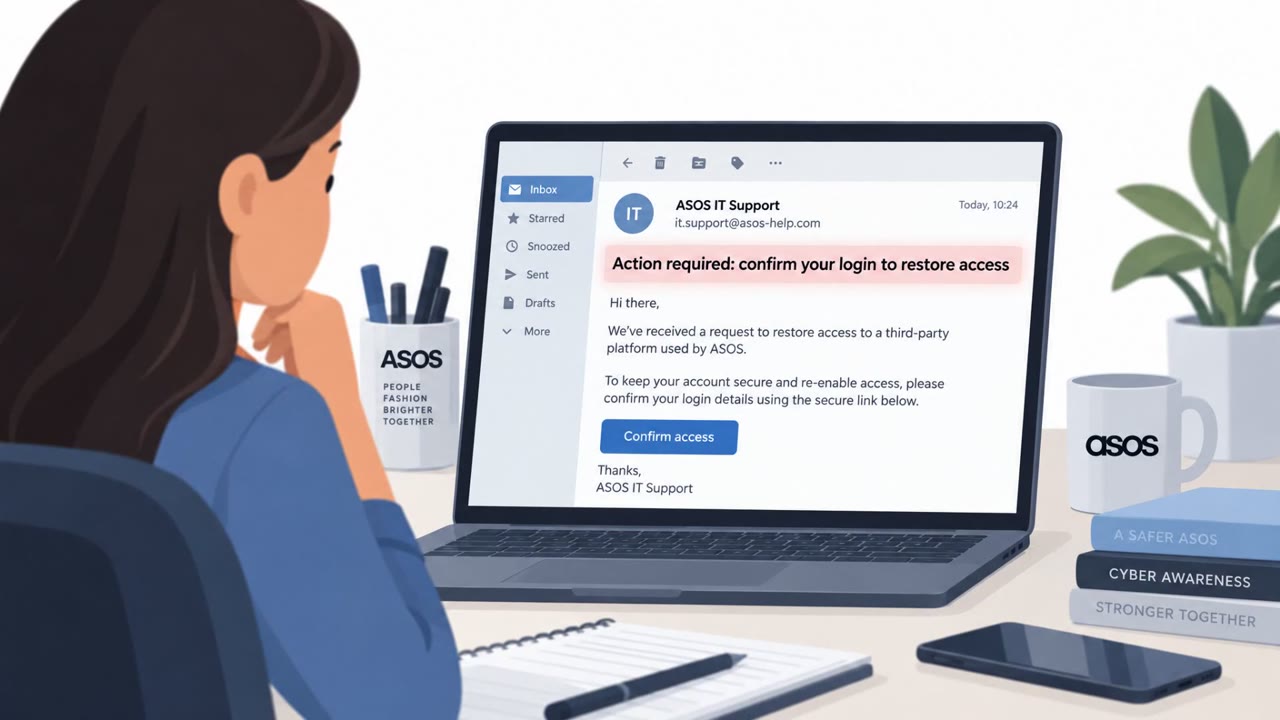
ASOS Breach Began With Tricked Employee Login

ASOS Breach Began With Tricked Employee Login

ASOS confirmed attackers got into customer-data systems after tricking an employee into handing over login credentials. Stolen data reportedly included not only names and contact details, but also customers’ shopping searches, which could enable highly convincing follow-on scams and phishing.…

October 9, 2026
ShinyHunters Impersonation Call Tricked ReliaQuest MFA

ShinyHunters Impersonation Call Tricked ReliaQuest MFA

ReliaQuest disclosed a real social engineering incident where attackers registered a lookalike domain, hosted a fake ReliaQuest SSO page, and called employees while impersonating a named security employee. One employee entered credentials and approved an MFA push, briefly giving the attacker…

August 25, 2026
Helix Extortion Hit Uber Freight via Helpdesk Vishing

Helix Extortion Hit Uber Freight via Helpdesk Vishing

Uber Freight is investigating unauthorized access after the Helix extortion group claimed it stole nearly one million files from company cloud and email repositories. Google-linked research says the broader cluster (UNC6671) commonly gets in by calling employees and posing as IT helpdesk staff…

August 12, 2026
BlackFile Crew Vishing Hits PE and Finance Firms

BlackFile Crew Vishing Hits PE and Finance Firms

Google and Reuters report a real vishing-led intrusion campaign tied to the extortion crew behind the retired “BlackFile” brand (tracked as UNC6671). Attackers call employees on personal phones spoofing the corporate IT help desk, push a same-day “passkey/MFA update,” and send them to a look‑alike…

August 12, 2026
Defense Supplier Tricked by Fake M365 Share Link

Defense Supplier Tricked by Fake M365 Share Link

IEH Corporation disclosed that an attacker got into its Microsoft 365 email environment after an employee clicked what looked like a legitimate Microsoft file-sharing link from a supposed new business contact. The fake link led to a phony login page that captured the employee’s credentials, letting…

August 7, 2026