Fake Sudo Prompt Steals Gov Admin Passwords

Unit 42 · High sophistication
Last updated October 15, 2026

Unit 42 reported an espionage-focused intrusion cluster (CL-UNK-1211) targeting government and state-affiliated Linux infrastructure from Oct 2025 to Apr 2026. While much of the campaign is technical (web shells, RATs and reverse shells), it also includes credential theft that relies on deceiving users, such as a fake sudo password prompt designed to look legitimate and quietly capture passwords.

Key findings

  • Targets were “government entities and state-affiliated infrastructure,” mainly on Linux, for intelligence-gathering and persistent access.
  • Attackers used AI-generated or AI-assisted scripts with “conversational, step-by-step reasoning notes.”
  • Initial access/persistence included “web shell deployment and credential harvesting.”
  • A user-deception credential theft method replaced .bashrc to create a fake sudo password prompt and log captured passwords.
  • Stolen passwords were written to a log file name meant to look legitimate: “Solarwinds.StatusLog.txt,” described as an evasion tactic.
  • Attackers also added a credential logger to a PHP login page to capture admin usernames/passwords.

Who’s being targeted

  • Commonly targeted roles: IT, Linux Administrators, DevOps, Engineering, Application Administrators, Database Administrators.
  • Affected industries: Government, State-affiliated infrastructure.
  • Attack channels: physical, website.
  • Impersonated: System sudo authentication prompt, Internal/hosted web application's admin login page.

Awareness takeaways

  • Treat unexpected password prompts as a red flag, especially on admin systems. If something feels off, stop and verify the system’s integrity (e.g., check for unauthorized .bashrc changes).
  • Monitor and tightly control changes to shell startup files and login pages, because attackers can use small edits to steal credentials silently.
  • Don’t trust “familiar” file names as proof something is safe; attackers may use recognizable names to hide malicious activity.

Red flags to watch for

  • Unexpected password prompts or repeated prompts when running sudo
  • Unusual files created in the user profile or working directory (e.g., a new *.txt log file)
  • Shell configuration files like .bashrc changed without a clear reason
  • Login page code/files changed unexpectedly
  • Admin credentials accessed/used soon after a login
  • New or unusual log files appearing on the server storing credentials
Try Mirage

Mirage safely runs attacks like this one against your own team, so you find out what happens before a real adversary does.

Get a demo
Read the video transcript

On our Linux admin boxes, even the sudo prompt can be a trap. Unit 42 saw an espionage crew swap .bashrc so every time you run sudo, a fake prompt grabs your password and quietly writes it into a file named Solarwinds.StatusLog.txt. The only clue you see? Sudden or repeated sudo password prompts, or weird new log files in your home directory, while an admin web login quietly logs usernames and passwords to another hidden file. If sudo suddenly feels off, stop. Before you type your password again, check your .bashrc and recent log files or call the security team to verify the box.

Categories

Similar attacks

Fake AI Apps and Signed Installers Spread Malware

Fake AI Apps and Signed Installers Spread Malware

A large review of “AI-enabled malware” found most samples were proof-of-concepts, but a small set were real threats seen in production environments. The real-world activity included trojanized installers that pretended to be legitimate apps (like a recipe app or a Dropbox installer) and relied on…

August 25, 2026
Fake GitHub Lure Tricks macOS Users Into Stealer

Fake GitHub Lure Tricks macOS Users Into Stealer

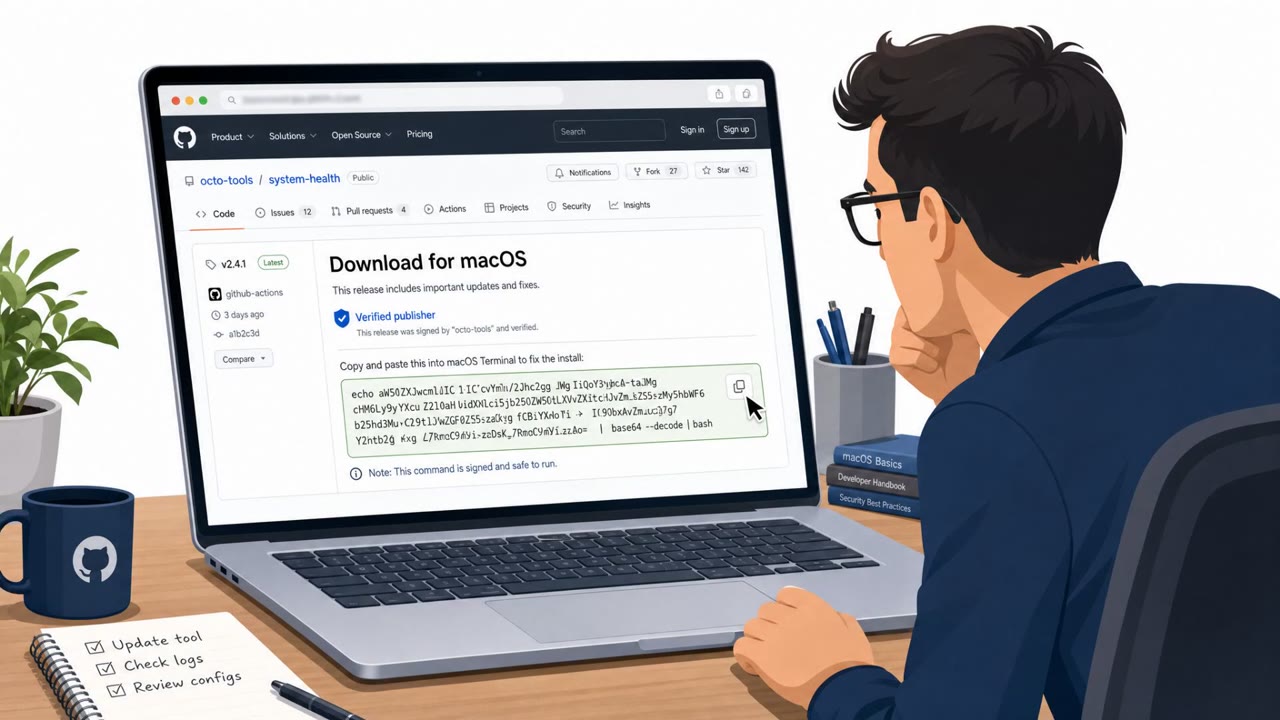
Researchers described AmnesiaStealer, a macOS info-stealer spread through a counterfeit “Download for macOS” page that tricks users into pasting a command into Terminal. The malware steals passwords and browser session data, and can even give an attacker live, hidden control of the victim’s browser…

August 17, 2026
Fake Dubai Airports Recruiters Push Dev Malware

Fake Dubai Airports Recruiters Push Dev Malware

Researchers reported an Iranian state-aligned actor impersonating the Dubai Airports IT department to lure a targeted Iraqi individual into installing a fake “careers portal” and then opening a weaponized coding test. The workflow looked like a real recruitment process (HR questions, then a…

October 6, 2026
Resume Phish Hit Brazil Banks; AI Aided Ops

Resume Phish Hit Brazil Banks; AI Aided Ops

Two real, ongoing intrusion campaigns targeted organizations in Latin America, including a Mexican transportation organization and Brazil’s financial sector. In the Brazil campaign, attackers reportedly got in via a resume-themed phishing attachment, then attempted to download and run tunneling…

September 3, 2026
Attackers Phish via Teams & Slack, Not Email

Attackers Phish via Teams & Slack, Not Email

Research and incident examples show attackers increasingly using trusted collaboration tools (like Microsoft Teams and Slack) to impersonate IT/support or known community members, then push victims to phishing sites, approve MFA prompts, or run malicious files. Because messages come through…

August 20, 2026
Fake LastPass GitHub Drops Rapuncel Stealer

Fake LastPass GitHub Drops Rapuncel Stealer

Attackers impersonated LastPass on GitHub and tricked people searching for the “LastPass Authenticator download” into installing a fake installer. The infection chain used a Microsoft-signed driver to disable many security tools, then deployed an infostealer that stole passwords, crypto wallets,…

September 23, 2026