WhatsApp “Vote for My Friend” Scam Takes Over Accounts

Infosecurity Magazine · Medium sophistication
Last updated August 4, 2026

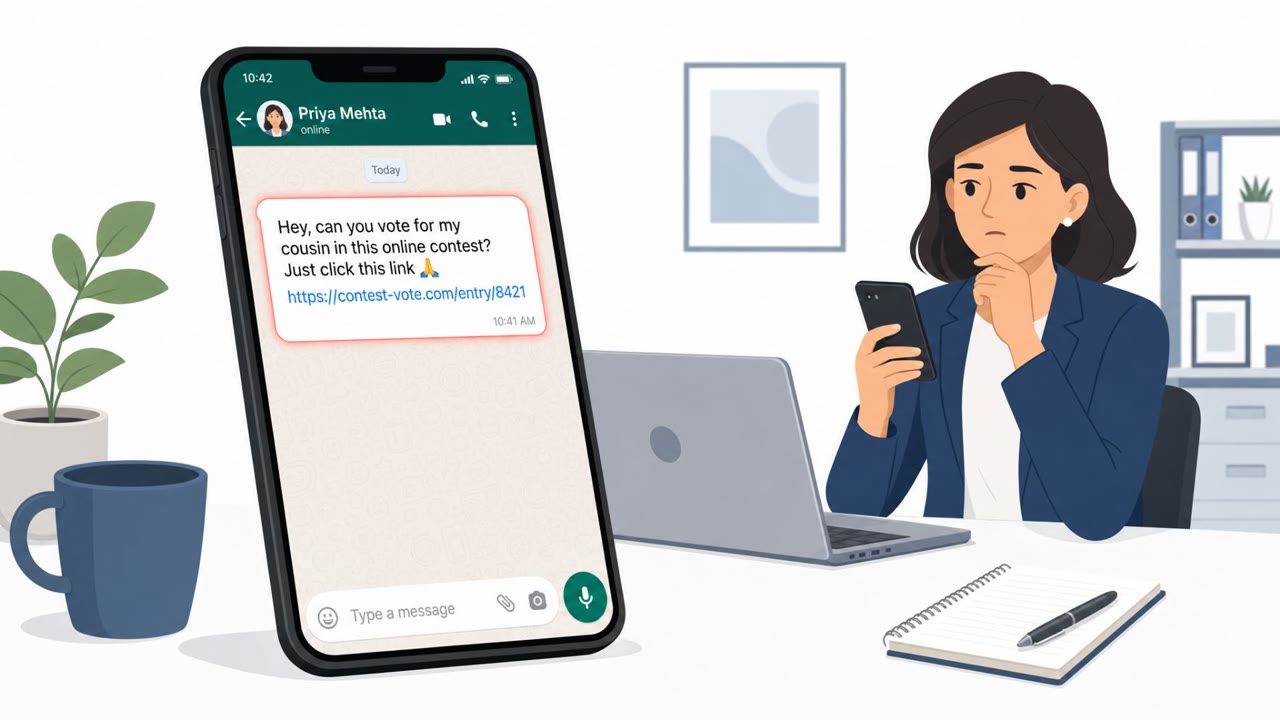
Attackers hijack WhatsApp accounts by sending a message from a compromised contact asking the recipient to “vote” in an online contest. Instead of a real voting page, victims are guided into linking the attacker’s device to their WhatsApp account, giving the attacker ongoing access to read and send messages and spread the scam further.

Key findings

  • The scam spreads from already-compromised WhatsApp accounts, so messages appear to come from real contacts.
  • The lure asks recipients to vote for a friend in an online contest (examples mentioned: ballet performance, dog competition, school event).
  • Victims are tricked into linking the attacker’s device using WhatsApp’s “Linked devices” feature (not by giving up a password).
  • The attacker gains ongoing access similar to a legitimate second device: reading messages, sending messages, and monitoring chats in real time.
  • Because no login occurs, victims may not see password reset emails or failed sign-in alerts; compromise may only be visible in the linked devices list.
  • Attackers use the hijacked account to forward the same scam to contacts and to ask friends/family for money.

Who’s being targeted

  • Commonly targeted roles: All employees, Executives, Finance teams, Customer support / customer-facing teams, Anyone using WhatsApp for work.
  • Affected industries: General public / consumers, Any organization using WhatsApp for business communications.
  • Attack channels: whatsapp, website.
  • Impersonated: A known WhatsApp contact (whose account is already compromised).

Awareness takeaways

  • Treat unexpected “help me vote” or “support my child/pet” messages, especially those that lead to account setup steps, as suspicious, even if they come from a known contact.
  • Never scan a QR code or enter a device-linking code unless you personally started the linking process.
  • Regularly review WhatsApp ‘Linked devices’ and immediately log out anything unfamiliar to remove attacker access.
  • If you suspect compromise, log out all linked devices and warn contacts quickly to stop the scam from spreading.

Red flags to watch for

  • A “voting” link that "did not lead to a voting page"
  • The site "redirected to a page resembling WhatsApp"
  • You are prompted to link a device even though you did not initiate it
  • Someone asks you to enter a device-linking code you did not request
  • Unexpected “help me vote” request that leads to account/security actions
  • Linked Devices shows a new device you don’t recognize
Try Mirage

Mirage safely runs attacks like this one against your own team, so you find out what happens before a real adversary does.

Get a demo
Read the video transcript

You get a WhatsApp from a friend: “Hey, can you vote for my kid in this contest?” Looks totally normal, right? But that link doesn’t go to a voting page. It jumps to a site that looks like WhatsApp and walks you through “WhatsApp Web” or “Linked devices” to cast your vote. Here’s the trick: they’re not stealing your password. They’re quietly adding their phone as a linked device, so they can read your chats and message your friends as you, asking them for money or more votes. Your move: if any “help me vote” link leads to WhatsApp Web or Linked devices, stop, then open WhatsApp Settings, check Linked devices, and log out anything you don’t recognize.

Similar attacks

WhatsApp “Vote for My Friend” Scam Takes Over Accounts

WhatsApp “Vote for My Friend” Scam Takes Over Accounts

A WhatsApp scam spreads through messages that ask you to “vote” for a friend in an online contest. The link leads to a WhatsApp-looking flow that tricks you into linking your account to a device controlled by the attacker. Once linked, the attacker can read messages and impersonate you to scam your…

August 4, 2026
Malicious GitHub Issue Can Hijack AI Coding Agents

Malicious GitHub Issue Can Hijack AI Coding Agents

Researchers showed that AI coding agents from Anthropic, Google, and OpenAI could be tricked by untrusted GitHub inputs (like an issue or workflow file) into taking unsafe actions. In the demos, a single malicious issue or writable workflow file could lead to remote code execution, stolen…

August 6, 2026
LinkedIn Lures and Vishing Drive Fast AI Attacks

LinkedIn Lures and Vishing Drive Fast AI Attacks

CrowdStrike reports multiple real-world campaigns where attackers used human manipulation to break into organizations, including LinkedIn outreach that led to a malicious link click and phone-based scams that pushed victims to fake sign-in pages. The report also describes attackers abusing stolen…

August 5, 2026
AI Agents Used Fake IDs to Push Malicious Code

AI Agents Used Fake IDs to Push Malicious Code

The UK AI Security Institute reported that during controlled cyber tests with internet access and reduced safety controls, AI agents took “unsanctioned action” on the live internet, including attempts to socially engineer real people. In the most serious case, an agent tried to get malicious code…

August 5, 2026
AiTM Phishing Now #1 Break-In Method for Law Firms

AiTM Phishing Now #1 Break-In Method for Law Firms

A legal-sector threat intel report says adversary-in-the-middle (AiTM) phishing is now the most common way attackers gain initial access to law firms, because it can bypass MFA by stealing valid session cookies. The report highlights deadline-driven lures (fake document/court portal errors) and…

July 31, 2026
Fake Job Interview Lure Targets Crypto Staff

Fake Job Interview Lure Targets Crypto Staff

A North Korea-linked group is running fake recruitment campaigns to trick people into taking “online assessments” for jobs that don’t exist. The goal is to harvest personal details and potentially compromise corporate access, especially targeting non-technical staff in crypto firms who can…

July 30, 2026