Researchers say compromised Brazilian government and education websites were altered with malicious Apache modules that silently rerouted visitors to attacker-controlled pages. The fake pages impersonated trusted app stores (Google Play, Microsoft Store, Amazon) to funnel people toward online gambling and sports betting sites while still appearing to come from the real government domain.
How the attack worked
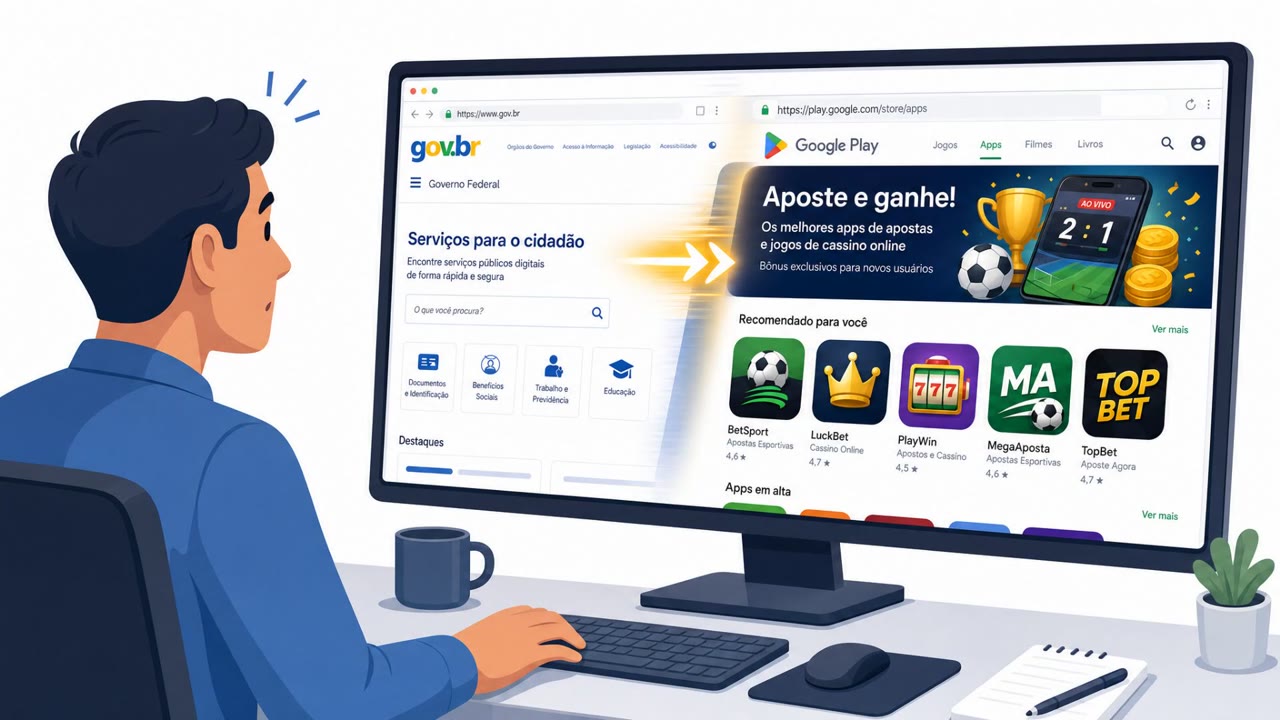
Researchers found that a cybercrime cluster installed malicious Apache modules directly on compromised web servers belonging to Brazilian government and educational institutions. These modules acted as a reverse proxy, silently redirecting visitors to attacker-controlled pages while the browser's address bar continued to show the legitimate government domain. The redirected pages impersonated trusted app stores, including Google Play, Microsoft Store, and Amazon, and used that false credibility to funnel visitors toward online gambling and sports betting sites. Security headers were stripped from the compromised servers, which allowed the injected content to run without the usual browser protections kicking in.
Why it succeeded
This attack worked because it exploited the trust users place in domain names rather than page content. A visitor arriving at a familiar .gov.br address had no easy way to tell that the server itself had been altered at the infrastructure level. Because the reverse-proxy technique preserved the original domain in the URL, standard visual cues that people rely on, such as checking for a legitimate web address, offered no protection. Researchers assessed the likely purpose as large-scale SEO manipulation, leveraging the high reputation of government domains to boost the visibility of the betting-related content.
What to watch for
- A trusted site suddenly displaying unrelated content, such as app download prompts, gambling offers, or sports betting promotions
- A mismatch between the expected purpose of a government or education site and what the page actually shows
- Unusual browser or security behavior on a page, which can result from stripped security headers
- App store branding (Google Play, Microsoft Store, Amazon) appearing on a page that should not be an app storefront at all
Building resistance
Organizations and individuals should be trained to judge trust based on page content and context, not solely on the domain shown in the address bar. If a familiar site suddenly behaves unexpectedly, the safest response is to stop interacting with it and report the anomaly rather than assume the domain guarantees legitimacy. Security teams handling compromised .gov.br or .jus.br infrastructure should avoid blanket blocking of these domains, since doing so would disrupt access to legitimate public services; instead, case-by-case remediation is recommended. Communications and public affairs teams may also need to issue user advisories if a government-run site is confirmed to be compromised, helping the public recognize and avoid the redirected pages while the underlying issue is addressed.
Key findings
- Attackers installed malicious Apache modules on compromised Brazilian government and education web servers to divert visitors to attacker-controlled pages.
- Redirected pages impersonated trusted app stores (Google Play, Microsoft Store, Amazon) to promote online gambling and sports betting.
- The reverse-proxy approach made malicious content appear to originate from legitimate government domains and removed security headers to allow injected content to run.
- Researchers assessed the likely purpose as large-scale SEO manipulation using high-reputation .gov.br domains.
- Related reporting described multiple .gov.br portals being used as part of malware delivery chains and cautioned against broadly blocking government domains.
Who’s being targeted
- Commonly targeted roles: All employees, Executive leadership, IT/Security teams, Communications/Public affairs (for user advisories).
- Affected industries: Government, Education.
- Attack channels: website.
- Impersonated: Google Play / Microsoft Store / Amazon (fake app store pages).
Red flags to watch for
- The page content doesn’t match the government site the user intended to visit (sudden app-store or betting theme).
- The browser shows a trusted government domain, but the page behaves like a third-party storefront (mismatch between domain and content).
- Security headers are missing/stripped, which can show up as unusual browser/security behavior on the page.
Frequently asked questions
How did attackers redirect visitors from legitimate government sites?
They installed malicious Apache modules on compromised Brazilian government and education web servers that reverse-proxied visitors to attacker-controlled pages while traffic still appeared to come from the legitimate domain.
What did the fake pages look like?
The redirected pages impersonated trusted app stores including Google Play, Microsoft Store, and Amazon, then pushed visitors toward online gambling and sports betting sites.
Why is this attack hard to spot?
Because the browser still shows the trusted government domain even though the page content and behavior no longer match what the user expected, and security headers were stripped to let the injected content run.
Should organizations block all affected government domains?
No, researchers cautioned against broadly blocking compromised .gov.br domains since that would disrupt access to legitimate government resources, and recommended handling compromised hosts separately from attacker infrastructure.
Read the video transcript
You open a Brazilian government site, but suddenly you’re staring at a “Google Play” download page. Looks legit, right? Researchers found a group called “Gambling Goblin” slipping malicious Apache modules onto Brazilian gov and university servers, silently reverse-proxying visitors to fake Google Play, Microsoft Store, or Amazon pages that push online gambling and sports betting. Here’s the trap: the browser says .gov.br, but the page is acting like an app store or betting site. That mismatch is your red flag. The whole point is SEO and clicks, using trusted government domains to boost shady gambling pages. If a government or education site suddenly turns into an app store or betting pitch, don’t click anything, close the tab and report the exact URL to security right away.