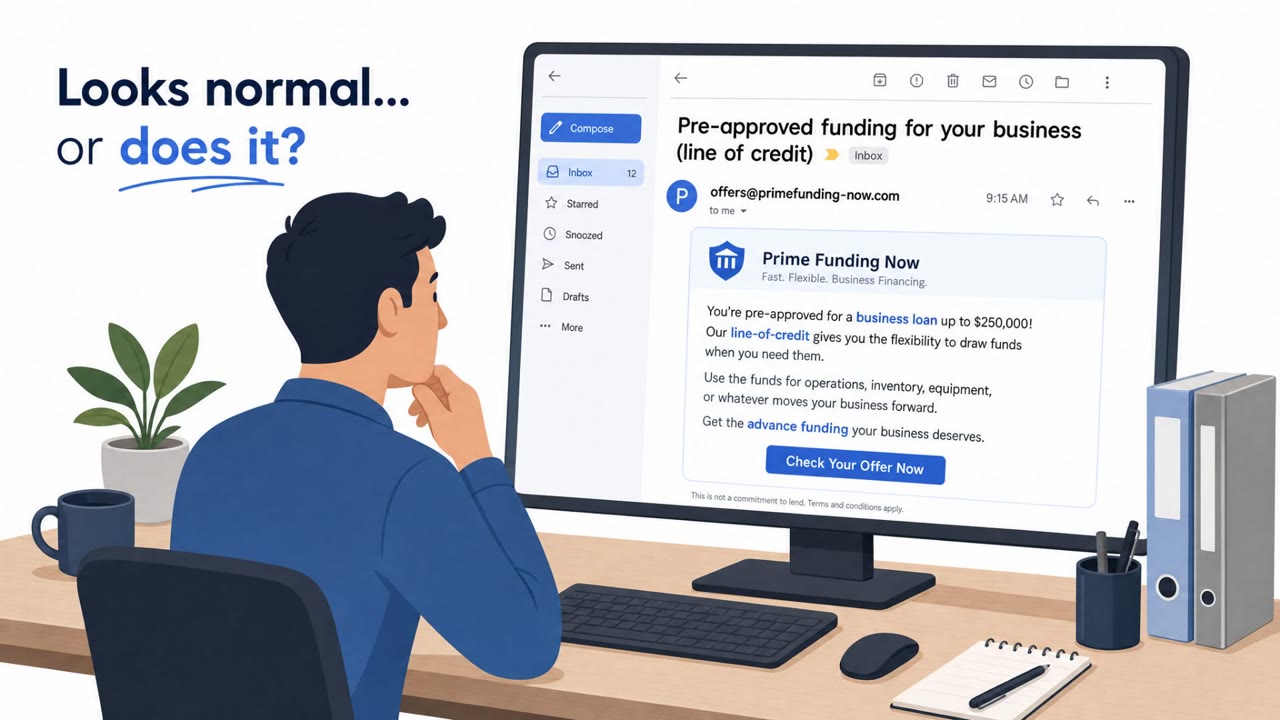
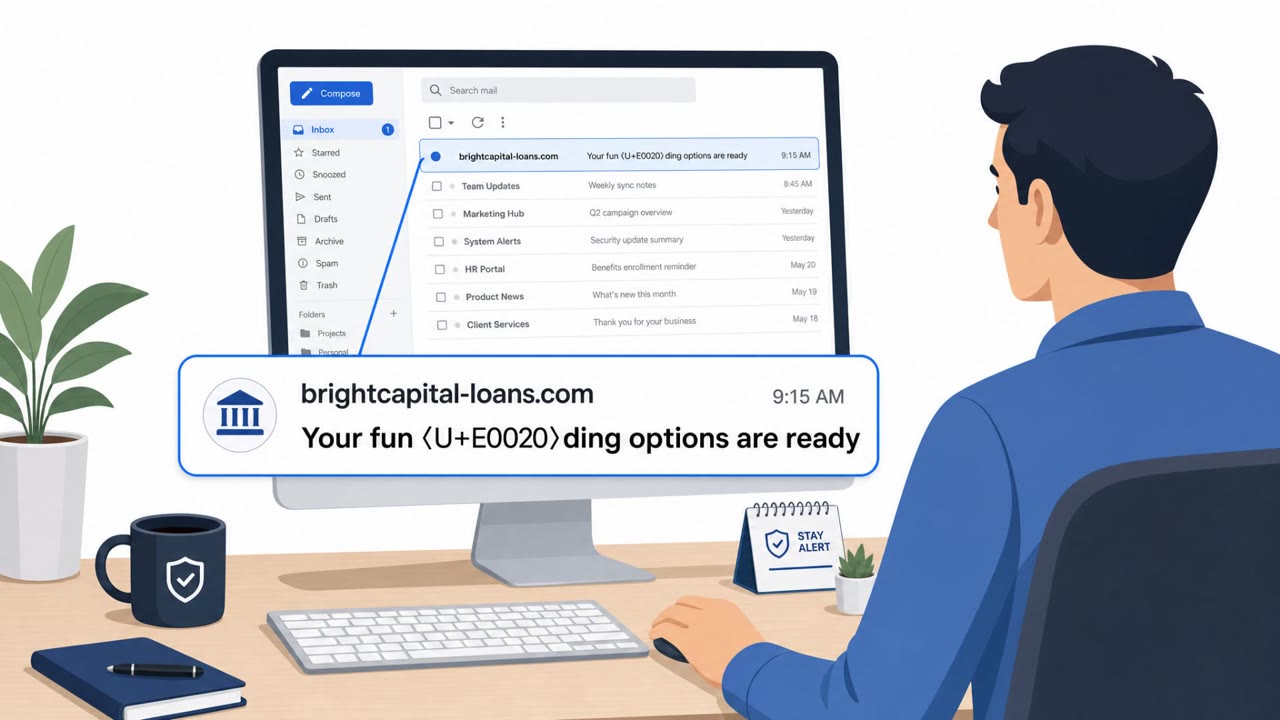
Microsoft researchers reported a real, high-volume phishing campaign that used invisible Unicode “tag” characters to break up finance-related lure words (like “funding”) so email filters wouldn’t detect them. The emails looked normal to recipients but contained hidden characters in the underlying text, helping the campaign send millions of finance-themed phishing messages over several months.
Key findings
- Microsoft observed a real, high-volume phishing campaign that inserted invisible Unicode tag characters into finance lure words to evade detection.
- Signature hits spiked starting February 9, 2026, peaking at “over 2.3 million messages” in a day, and persisted for roughly three months with a weekday-only cadence.
- The campaign used Unicode Tags block characters (U+E0000 to U+E007F), inserting single invisible separators inside words (e.g., “funding” split by TAG SPACE U+E0020).
- Most messages clustered around ~150 finance-themed sender domains with business loan/line-of-credit/advance-funding lures.
- Microsoft notes this is an old evasion idea (breaking keywords with invisible characters), but new in its character choice (Unicode Tags block) and scale.
Who’s being targeted
- Commonly targeted roles: Finance, Accounts Payable, Executive assistants, Business operations, All employees (email users).
- Affected industries: Small and medium businesses (general), Finance-themed marketing/loan-related targeting (cross-industry).
- Attack channels: email.
- Impersonated: A business lender or funding provider using a finance-themed sender domain.
Awareness takeaways
- Treat unsolicited ‘business funding’ or ‘line of credit’ emails as suspicious, especially when they come from unfamiliar domains.
- If an email seems to be ‘dodging’ scanning (e.g., odd copy/paste behavior or inconsistent text), report it, attackers can insert invisible characters that humans won’t notice.
- Security teams should verify that email security tools normalize/handle Unicode tag characters, not just common zero-width spaces.
Red flags to watch for
- Sender domain is disposable and finance-themed rather than a known lender
- Email contains manipulated text that ‘looks normal’ but includes hidden/invisible characters
- High-pressure/unsolicited funding or credit offer sent in bulk
Read the video transcript
There’s a new finance phishing wave where the scam text looks normal to you, but not to our filters. Microsoft caught a campaign sending millions of emails that secretly split words like 'funding' with invisible Unicode tag characters so keyword filters miss them. These come from random loan domains, promise fast business funding or a line of credit, and push you to click through and fill out an application with your business and identity details. If you get an unsolicited business funding or line-of-credit email from an unknown domain, don’t click, report it to security and delete it.