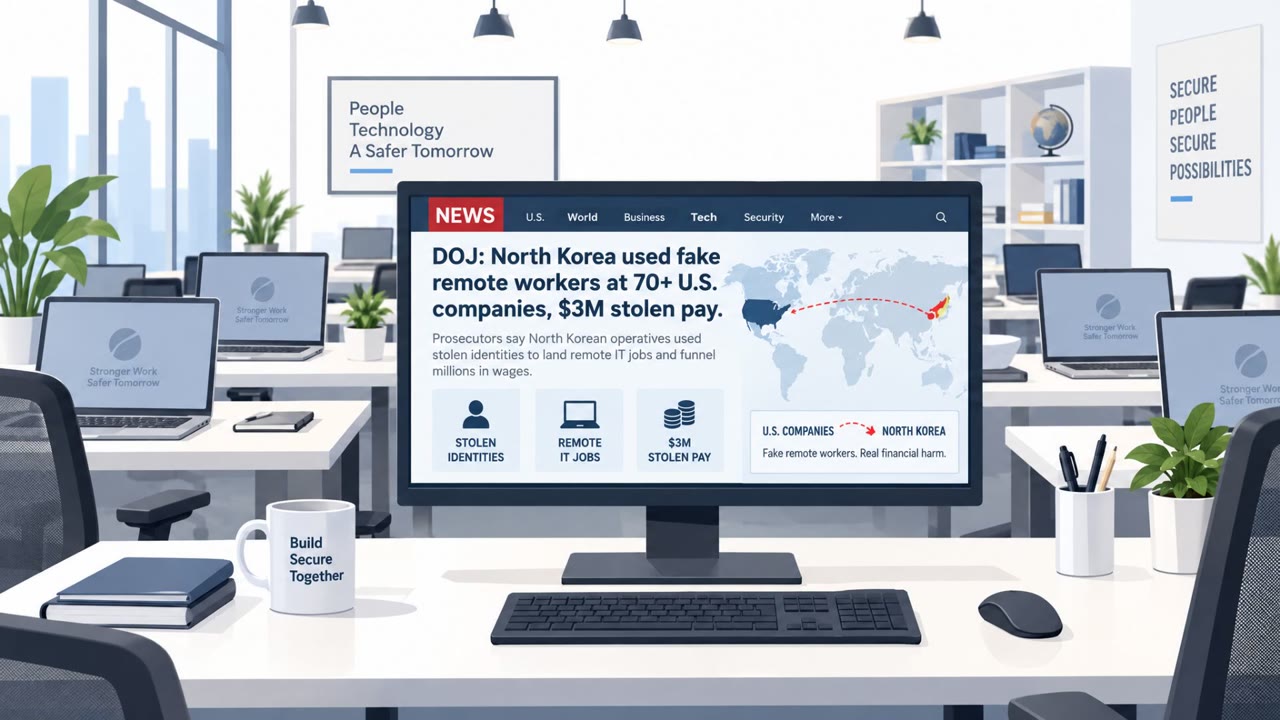
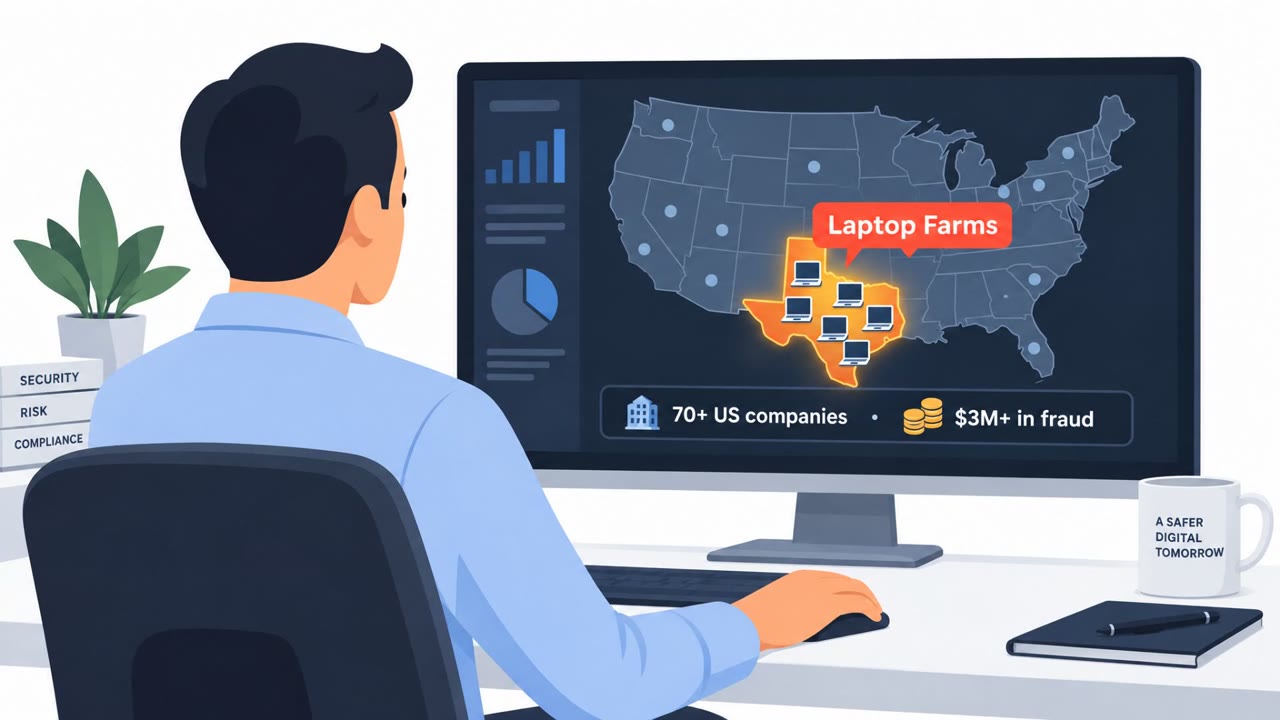
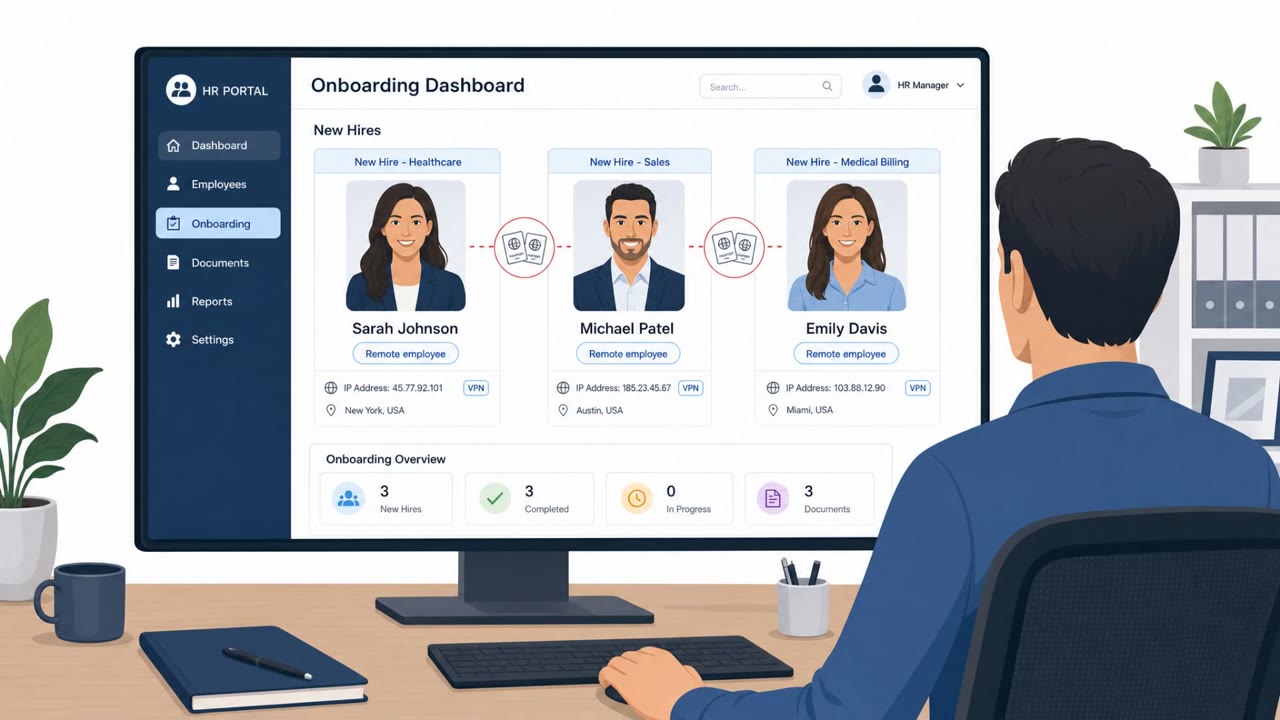
US authorities say North Korean operatives used stolen and fake identities to get hired into remote roles at more than 70 US companies, then operated company laptops from inside the US using “laptop farms.” Americans allegedly helped by receiving employer-issued laptops, keeping them online, and enabling remote access, sending millions in wages back to North Korea.
How the scheme worked
According to US authorities, North Korean IT workers used stolen and fabricated identities to get hired into remote roles at more than 70 US companies. Once hired, the operatives relied on US-based helpers to receive employer-issued laptops and keep them running from residential locations, often called laptop farms. These helpers installed remote-access software so the real operator, based overseas, could log in and work as if present in the United States, defeating geolocation-based fraud controls and identity verification systems built for legitimate employment.
Why it succeeded
The scheme combined several layers of deception that each targeted a different stage of the hiring pipeline. Stolen and fabricated identities bypassed initial screening. Paid US-based stand-ins appeared on camera during interviews to pass visual identity checks, and some individuals lent social media or professional networking accounts to add credibility. The FBI noted operatives strategically target people under financial stress, who may be more willing to accept payment for seemingly low-effort tasks like receiving packages or logging into accounts.
What to watch for
- Applicant identity details that are inconsistent, unverifiable, or change between interactions
- Shipping addresses or onboarding locations that do not match a candidate's claimed location
- Candidates whose appearance, voice, or behavior shifts between interview rounds, or who resist additional verification steps
- Company laptop geolocation or ISP patterns that do not match an employee's claimed work location
- Unexpected installation of remote-access or remote administration tooling on company hardware
- Multiple company laptops traced to a single residential address
Building resistance
Organizations hiring for remote roles should treat onboarding as a security control, not just an HR process. Strengthening identity verification, watching for stand-ins during video interviews, and flagging unusual shipping or device patterns can help catch this activity early. Employees and contractors should also be trained that offers to help with verification, including appearing on camera for someone else, lending accounts, or shipping packages on another person's behalf, are illegal and risky; the FBI has warned that participants face law enforcement scrutiny. Finally, managers and security teams should be prepared for retaliation or extortion attempts after termination, including threats to leak corporate data, and should route any such incidents through legal, HR, and security channels rather than engaging directly with the threat actor.
This case illustrates how identity-based social engineering can extend well beyond phishing emails into the hiring process itself, requiring coordination between recruiting, HR, IT onboarding, and security teams to close the gaps attackers are exploiting.
Key findings
- North Korean IT workers used stolen and fabricated identities to obtain remote jobs at 70+ US companies.
- US-based “laptop farms” enabled operatives to receive employer hardware, defeat geolocation checks, and maintain covert access.
- Americans were allegedly paid to appear on camera for interviews, verify identities, lend accounts, or ship packages; financially stressed individuals were targeted.
- The scheme generated millions in wages; the FBI also warned of retaliation/extortion threats after termination in some cases.
Who’s being targeted
- Commonly targeted roles: HR, Recruiting/Talent Acquisition, Hiring managers, IT onboarding/Provisioning, IT security, Managers of remote employees.
- Affected industries: Healthcare, Communications, Retail, Manufacturing, Professional, Scientific, and Technical Services.
- Attack channels: website.
- Impersonated: Job applicant using a stolen/fake identity, Job candidate (stand-in) during video interview, Legitimate employee (remote worker) operating from the US.
Red flags to watch for
- Applicant identity cannot be reliably verified (inconsistent or unverifiable details)
- Shipping address or onboarding location does not match the applicant’s claimed location
- Unusual urgency or pressure to complete identity verification/onboarding steps
- Candidate appearance/voice/behavior changes between interview rounds
- Reluctance to perform additional verification steps or inconsistencies in personal history
- Requests to avoid certain verification methods or to switch platforms unexpectedly
- Company laptop geolocation/ISP patterns don’t match the employee’s claimed work location
- Unexpected remote-access software installation or unauthorized remote tooling
- Multiple company laptops observed at a single residential location (potential “laptop farm”)
Frequently asked questions
What is a laptop farm in this scheme?
It is a US-based location where Americans keep employer-issued laptops running and enable remote access so overseas operatives can work as if they were physically in the US.
How did the operatives pass identity and video interview checks?
Prosecutors allege operatives paid Americans to appear on camera during job interviews, verify fake identities, or lend social media and professional networking accounts.
What red flags should HR and IT watch for during remote hiring?
Watch for shipping addresses that don't match a candidate's claimed location, inconsistent or unverifiable applicant details, and multiple company laptops later appearing at a single residential address.
What happened to Americans who helped with the scheme?
According to the FBI, participants who received devices, ran remote-access software, or appeared on camera for operatives were allegedly paid, but the bureau warned these actions are illegal and put participants at risk of law enforcement scrutiny.
Read the video transcript
North Korean IT workers have already slipped into 70-plus US companies by faking remote hires. Here’s the trick: they steal or fabricate an identity, get hired remotely, then have the laptop shipped to a US helper’s home, a “laptop farm” that keeps your company device online for someone overseas. They even pay Americans under financial stress to appear on camera for interviews, verify fake IDs, or lend LinkedIn-style accounts, so the person you see isn’t the one using the laptop. Aha moment: that odd shipping address or stand-in on video is a security alarm. If an applicant’s identity or laptop destination feels off, pause hiring and report it to Security immediately.