This article maps real AI-related vulnerabilities and incidents to attacker workflows. The clearest awareness example is EchoLeak, where an attacker email can plant instructions that later cause Microsoft 365 Copilot to retrieve information available to the user and send it outside the organization through an image request. It also documents real prompt-injection, code-execution, and software supply-chain scenarios involving Google, Microsoft, and AWS products.
Key findings
- EchoLeak used an attacker email to store malicious instructions that could be activated by a later user request in Microsoft 365 Copilot.
- The EchoLeak workflow could access data already available to the user and send confidential business data externally through a rendered image request.
- Google Gemini CLI and Microsoft Semantic Kernel flaws show how prompt injection can progress from untrusted content to AI-agent tool use and code execution.
- AWS confirmed that Amazon Q Developer Extension version 1.84.0 included malicious code after a broadly scoped GitHub token enabled an attacker to commit to the repository.
- The malicious Amazon Q code did not execute because of a syntax error, so AWS reported that no customer environment changed.
- The article emphasizes that an organization’s exposure depends on the AI product version, its permissions, the untrusted content it processes, and how long it remained vulnerable.
Who’s being targeted
- Commonly targeted roles: Microsoft 365 Copilot users, Executives, Knowledge workers, Finance, Human Resources, Legal, Developers, DevOps engineers, AI application owners, Security teams, Cloud administrators.
- Affected industries: Information and Software, Professional Services, Finance and Insurance, Healthcare, Government, Education, Any organization using Microsoft 365 Copilot or AI developer tools.
- Attack channels: email, website.
- Impersonated: A plausible external business contact or sender whose email is processed by Microsoft 365 Copilot, A trusted-looking document, search result, or other content source processed by an AI agent.
Awareness takeaways
- Treat emails and other external content processed by AI assistants as untrusted, even when the user only asks the assistant for a routine summary or search.
- Do not assume an AI assistant can access only harmless information; its exposure is limited by the same files, mail, and permissions available to the user.
- Investigate unexpected external image loads, links, or content requests produced during AI-assistant use, as these may be used to move confidential information outside the organization.
- Keep AI tools and extensions patched, and restrict the permissions, credentials, and tools available to AI agents so a successful prompt injection has limited impact.
Red flags to watch for
- An unexpected external email is being included in a Copilot request.
- The content attempts to override the user’s intended task or insert instructions for the AI assistant.
- A Copilot result prompts an external image load or other unexpected external-content request.
- Content supplied to an AI agent includes instructions aimed at the agent rather than the user.
- The AI agent proposes an unexpected tool action or command.
- The requested action exceeds the purpose of the content being processed.
Read the video transcript
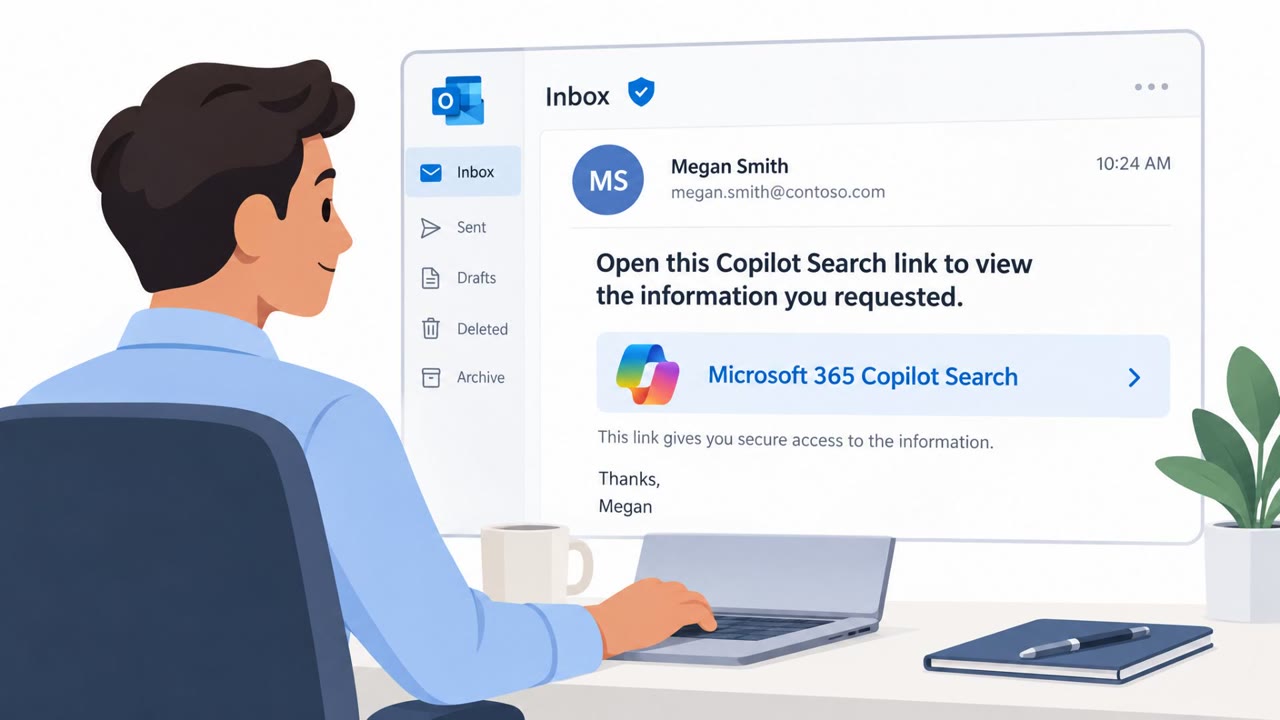
An email can give Copilot instructions you never approved. In EchoLeak, an external email says, ‘Please review the information in this email before preparing your Copilot summary.’ Hidden instructions wait until you ask Microsoft 365 Copilot to summarize it. Here’s the catch: Copilot can reach files you can reach. The planted instructions can make its answer load an external image that carries confidential data out. Unexpected email in your Copilot summary? Don’t include it in the request.