CERT-UA reports a real phishing campaign linked to Russia-aligned actor UAC-0099 targeting Ukrainian organizations. Victims receive an email with an image attachment that leads (via a link shortener) to a file-sharing download, where a disguised script installs a trojanized Notepad++ plugin and sets up persistence. The malware chain includes a loader designed to misbehave if analysts run it incorrectly, making investigation harder.
How the Attack Worked
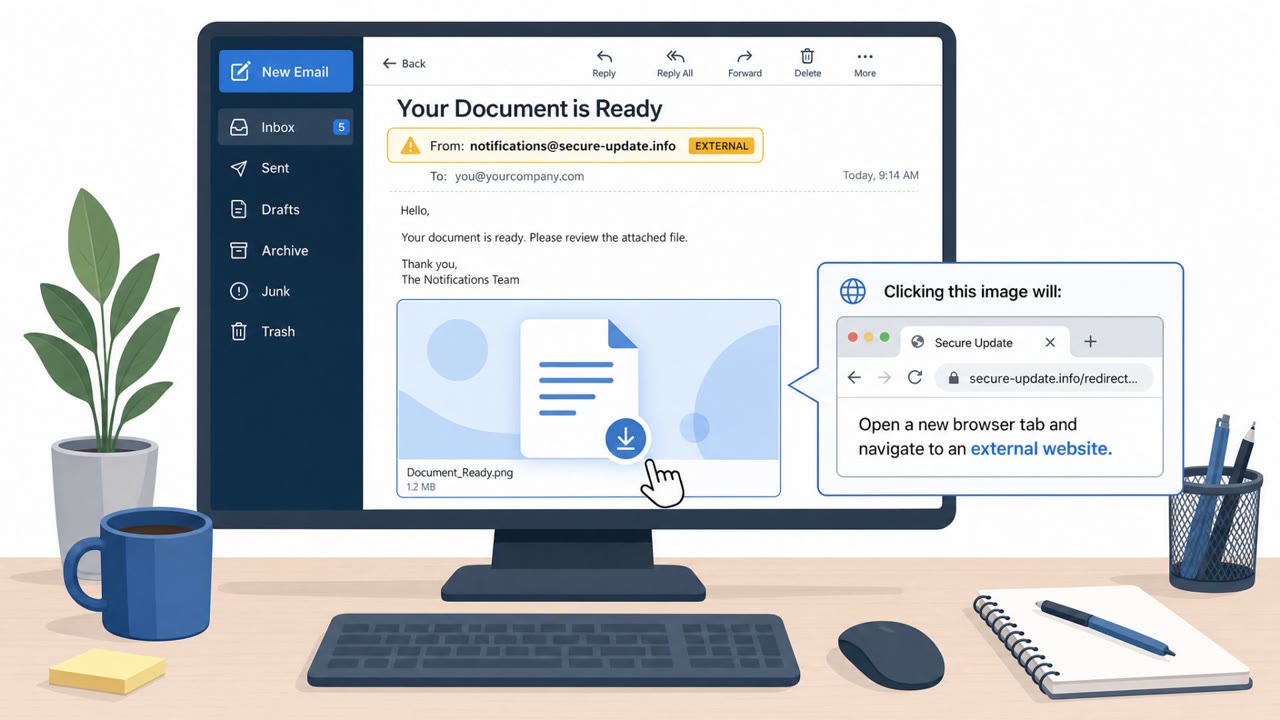
CERT-UA linked this campaign to a Russia-aligned actor tracked as UAC-0099, targeting Ukrainian organizations, particularly in government and public sector environments. The chain begins with a phishing email carrying an image attachment. Clicking the image leads through a link shortener that redirects to a file-sharing service hosting a ZIP archive. Inside the ZIP is a VBScript file disguised as a PDF document, using a double extension and extra spaces in the filename, such as "Zavodskyi rayon.pdf .vbs", so the file appears to be a harmless document at a glance.
Once opened, the script displays a decoy PDF to keep the victim occupied while it quietly downloads a package containing a full Notepad++ installation bundled with a malicious plugin DLL. That plugin unpacks a password-protected archive using a bundled WinRAR executable and creates a scheduled task to relaunch a loader every three minutes, establishing persistence on the system.
Why It Succeeded
The attack layers several deception techniques rather than relying on one trick. An image attachment feels benign, a link shortener hides the true destination, and a file named to look like a PDF exploits the common habit of trusting document extensions without checking closely. Bundling the malicious plugin with a legitimate, full copy of Notepad++ also adds a layer of camouflage, since the software looks and functions like the real tool.
What to Watch For
- Unexpected emails where an image attachment is the call to action leading to a download
- Links behind shorteners that redirect to file-sharing sites for ZIP downloads
- Filenames with double extensions or unusual spacing before the true extension, such as ".pdf .vbs"
- Scheduled tasks or background processes appearing shortly after opening a downloaded file
Building Resistance
Organizations should treat unexpected image-attachment emails that lead to link-shortener downloads as high risk regardless of how convincing the content looks. Staff training should specifically cover filename tricks like double extensions and excessive spacing, since these are easy to miss visually. CERT-UA also recommends keeping commonly abused tools such as WinRAR, 7-Zip, and Notepad++ updated, since attackers may exploit known vulnerabilities in these tools during later stages of an intrusion. Combining technical controls, such as blocking scheduled task creation from unusual locations, with awareness training focused on this specific delivery chain gives defenders the best chance of catching the attack before persistence is established.
Key findings
- Attack begins with a phishing email that includes an image attachment; clicking it leads to a shortened link that redirects to a file-sharing site hosting a ZIP.
- The ZIP contains a VBScript disguised as a PDF using a double extension and spaces (example: “Zavodskyi rayon.pdf .vbs”).
- The script opens a decoy PDF to distract the victim while downloading “Evernote.zip,” which contains a full Notepad++ package plus a malicious plugin DLL (NppExport.dll).
- The malicious plugin (LUNCHPOKE) unpacks a password-protected archive using a bundled WinRAR executable and creates a scheduled task to run a loader every three minutes.
- The loader (BURNYBEAR) intentionally exhausts CPU/RAM if executed without required arguments, complicating sandboxing and analysis.
Who’s being targeted
- Commonly targeted roles: All employees, Administrative staff, Operations teams, Executive assistants, IT/helpdesk (for user reporting and triage).
- Affected industries: Government / public sector, Defense (mentioned as prior targeting).
- Attack channels: email, website.
- Impersonated: Unspecified sender (phishing email), Unspecified file/document sender.
Red flags to watch for
- Image attachment used as a click-through lure to a website
- Link shortener hides the true destination
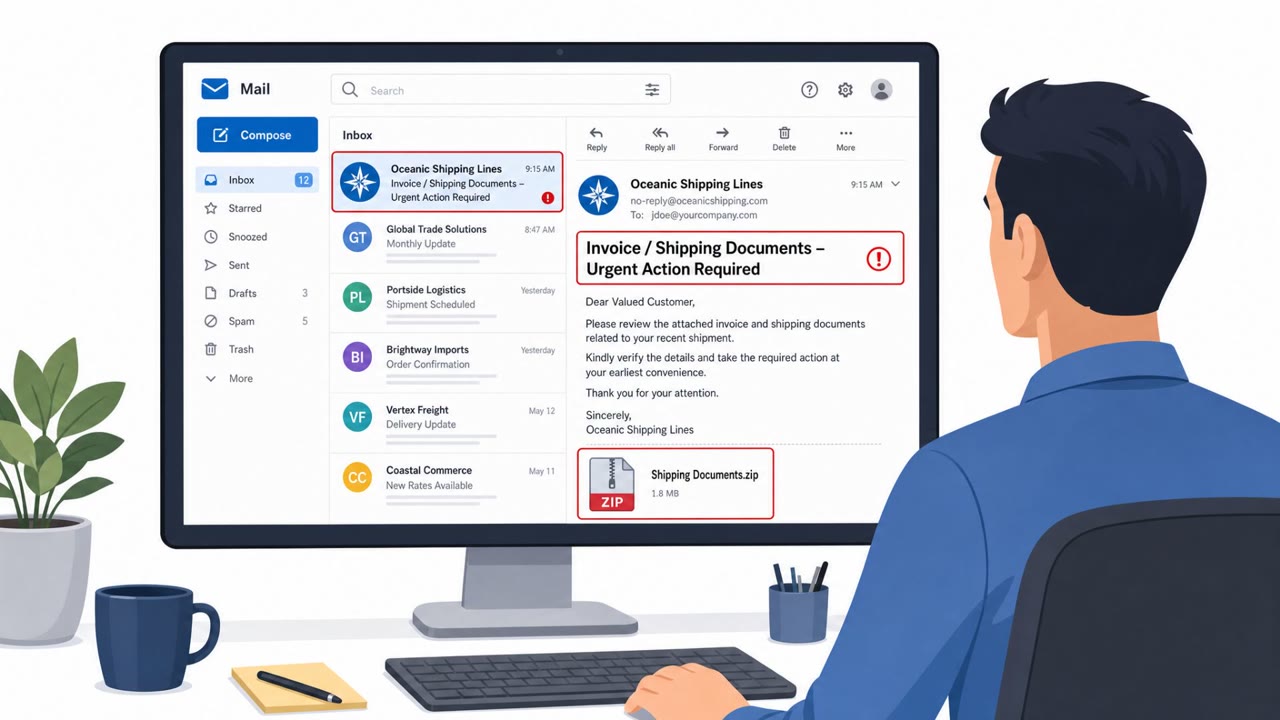
- Unexpected ZIP download from a file-sharing service
- Double extension (e.g., .pdf .vbs)
- Unusual extra spaces before the real extension
- .vbs script delivered where a PDF is expected
Frequently asked questions
How does the fake Notepad++ plugin attack start?
It begins with a phishing email carrying an image attachment. Clicking the image opens a link shortener that redirects to a file-sharing service hosting a ZIP archive.
What makes the malicious file inside the ZIP hard to spot?
The ZIP contains a VBScript disguised as a PDF using a double extension and extra spaces, for example "Zavodskyi rayon.pdf .vbs", so victims believe they are opening a document.
What happens after the script runs?
The script opens a decoy PDF to distract the victim while downloading a package containing a full Notepad++ install plus a malicious plugin DLL that unpacks a loader and sets up a scheduled task to run it repeatedly.
Why is this malware hard for analysts to investigate?
The loader intentionally exhausts CPU and RAM if run without the correct arguments, which complicates sandboxing and analysis attempts.
Read the video transcript
Picture this: email hits your inbox with an innocent image attached, click it, and you’re suddenly downloading a ZIP from some EasySend-style file share. Inside that ZIP is a fake “PDF” named exactly like this: “Zavodskyi rayon.pdf .vbs”. Open it, and a decoy PDF pops up while a hidden script quietly pulls down “Evernote.zip” with Notepad++ plus a trojan plugin called NppExport.dll. That plugin, LUNCHPOKE, quietly unpacks more payloads with a bundled WinRAR, sets a scheduled task, and a loader called BURNYBEAR even hammers CPU and RAM if analysts run it wrong, this is real CERT-UA–reported tradecraft, not a toy phish. Your move: if an email image click sends you to a shortened link and then a ZIP download, stop right there and report it to security, don’t open the ZIP, don’t touch that “.pdf .vbs”.