M365 Outage Lure Drives Credential Phishing

Infosecurity Magazine · Medium sophistication
Last updated November 17, 2026

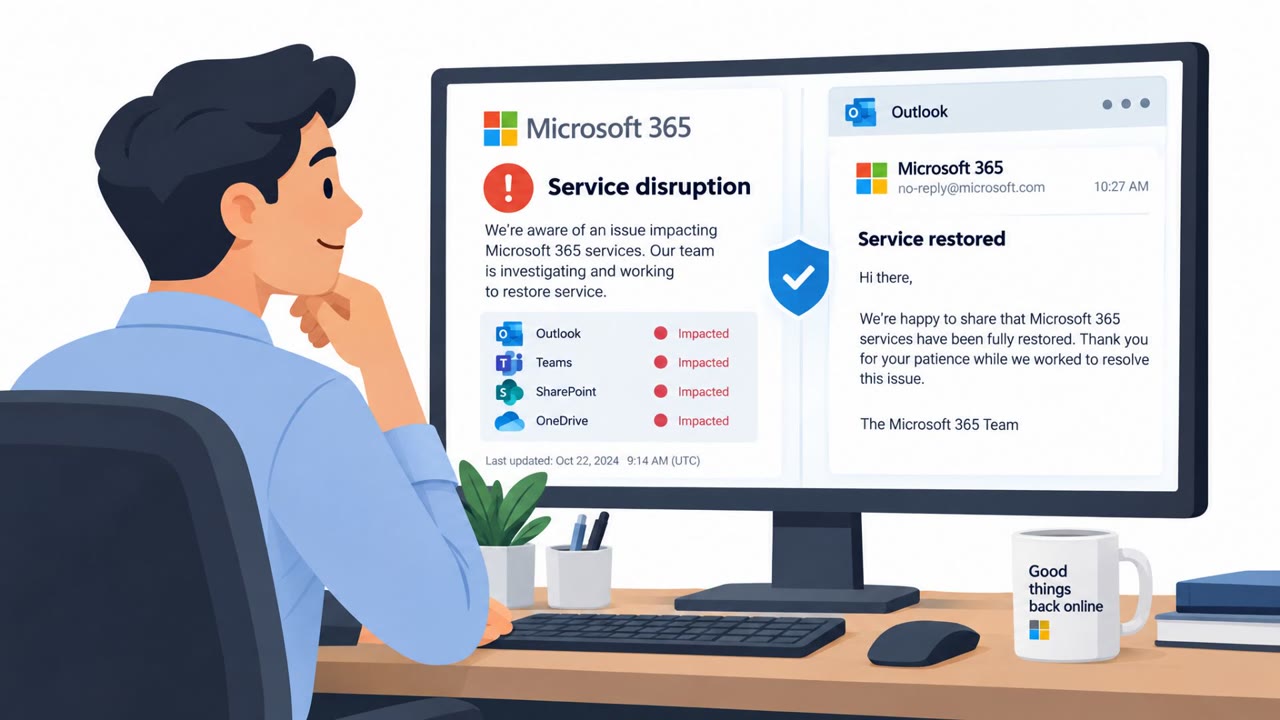
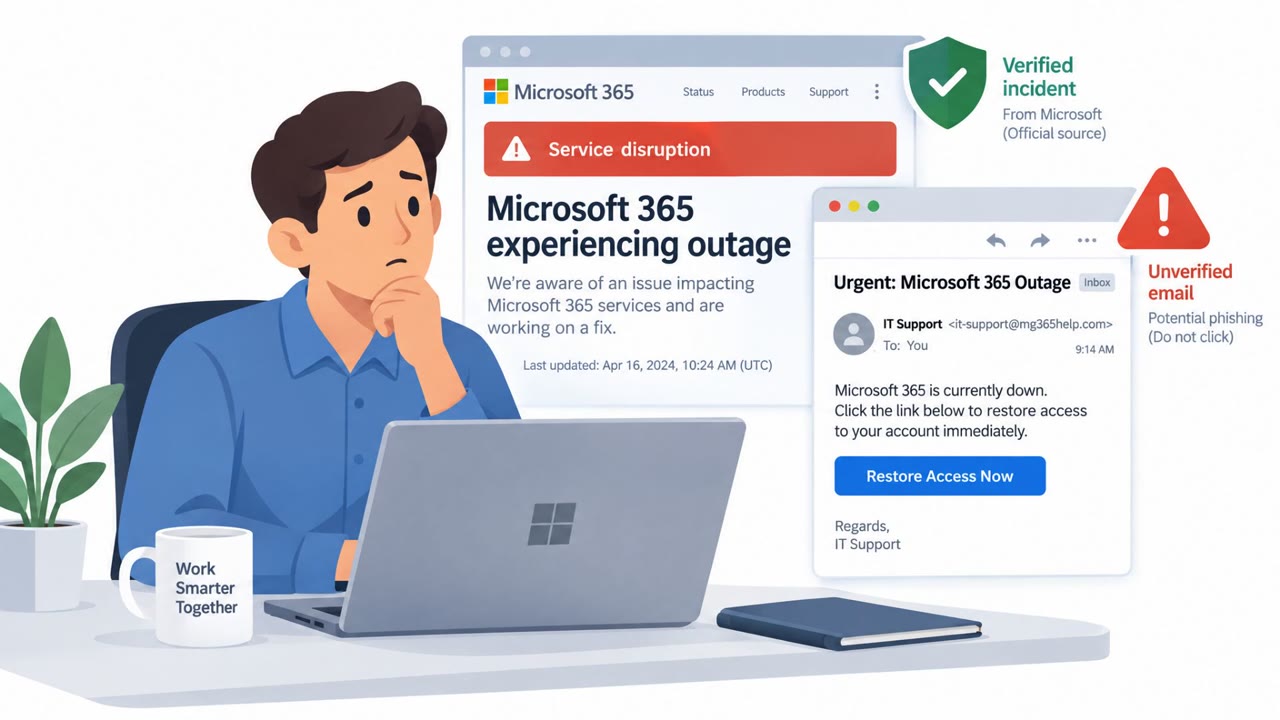
Attackers exploited a real Microsoft 365 outage with fake service-health emails that warned recipients their held messages would be deleted within 24 hours. The emails impersonated Microsoft notifications and pushed users to click a “RESTORE MESSAGES” link leading to credential-phishing sites. Microsoft had not observed confirmed credential theft or account compromise from this campaign at the time of reporting.

Key findings

  • The global, high-volume campaign was observed on November 13 during a Microsoft 365 service outage.
  • Emails impersonated Microsoft 365 service-health notifications and claimed emails held during the outage would be deleted within 24 hours.
  • The attackers used subject lines following the pattern “Outage – <random token>” and display names ending in “Outage Notification” or “Service Health.”
  • Messages used prominent “RESTORE MESSAGES” links and recipient-specific tracking URLs to drive clicks.
  • The campaign was link-based, with no QR codes, attachments, or identified malware payloads.
  • Microsoft did not attribute the campaign to a named threat actor and had not confirmed credential capture or post-compromise activity.

Who’s being targeted

  • Commonly targeted roles: All employees, Microsoft 365 users, Outlook users, Teams users, Service desk teams, IT and security teams.
  • Affected industries: Multiple industry sectors, Organizations using Microsoft 365, Information and Media.
  • Attack channels: email, website.
  • Impersonated: Microsoft 365 Service Health, Microsoft 365 service notification.

Awareness takeaways

  • Treat urgent outage-recovery messages with suspicion, especially when they threaten deletion or loss of email within a short deadline.
  • Verify service notices through the normal Microsoft 365 portal or internal IT channels instead of using links in an unexpected email.
  • Check the sender domain closely; a message that looks like a Microsoft service alert may come from an unrelated domain.
  • Report suspected phishing promptly, and if credentials were entered after clicking a link, contact security or IT immediately so access can be secured.

Red flags to watch for

  • An unexpected sender domain rather than an official Microsoft domain
  • A 24-hour deletion deadline intended to create urgency
  • A link asking the recipient to restore messages after an outage
  • The sender uses domains such as moments-notice[.]com, planetmaison[.]com, or newbooker[.]com
  • The message uses a recipient-specific tracking link instead of a normal Microsoft sign-in route
  • A supposedly Microsoft-related restoration process leads to reallifeaccounting[.]com
Try Mirage

Mirage safely runs attacks like this one against your own team, so you find out what happens before a real adversary does.

Get a demo
Read the video transcript

The Microsoft 365 outage was real. This recovery email wasn’t. On November thirteenth, fake Service Health emails said held messages would be deleted in twenty-four hours. The big RESTORE MESSAGES link led to a credential-phishing site. Here’s the giveaway: the sender could be moments-notice dot com, and the link goes to reallifeaccounting dot com, not Microsoft. A real outage doesn’t make that link safe. Get an outage alert? Open your usual Microsoft 365 portal yourself to check it.

Similar attacks

Outage Alerts Used to Steal Microsoft 365 Logins

Outage Alerts Used to Steal Microsoft 365 Logins

Attackers exploited a real Microsoft 365 outage by sending fake service-health alerts that warned employees their held email would be deleted within 24 hours. The messages pushed recipients to click “RESTORE MESSAGES,” leading through tracking links to a non-Microsoft website intended to capture…

November 17, 2026
Phishers Exploit Microsoft 365 Outage Alerts

Phishers Exploit Microsoft 365 Outage Alerts

Attackers exploited a real Microsoft 365 outage by sending fake service-health emails that appeared to be Microsoft notifications. The messages warned recipients that emails delayed during the outage would be deleted within 24 hours unless they clicked a link, likely to steal credentials.

November 16, 2026
Stolen Faces Fuel North Korean Meeting Scams

Stolen Faces Fuel North Korean Meeting Scams

North Korean operators behind “FaceStealer” hijacked accounts and used recordings of real people in fake Zoom and Microsoft Teams meetings. They used the familiar faces of trusted contacts to convince targets to install supposed fixes for technical problems, enabling malware installation, account…

November 14, 2026
North Korea Scales AI-Powered Job Scams

North Korea Scales AI-Powered Job Scams

Microsoft reports that North Korean threat actors are using AI to make job scams, fake recruiter outreach, fraudulent worker identities, and targeted phishing campaigns faster and more convincing. One group posed as recruiters for a spoofed AI blockchain company and scheduled software-engineer…

October 29, 2026
Fake Meetings and Listings Trap Victims

Fake Meetings and Listings Trap Victims

This weekly roundup describes several real-world social-engineering attacks with practical lures that can be used in awareness training. Attackers used a fake Teams scheduler to capture a sign-in approval, fake Zillow pages to persuade apartment hunters to run a copied command, and fake Zoom or…

November 15, 2026
AI Slop Weakens TA4903 Phishing Lures

AI Slop Weakens TA4903 Phishing Lures

Proofpoint says the BEC and phishing group TA4903 has used AI-generated email lures and phishing websites while impersonating US government entities. Rather than making the campaign more convincing, AI use reportedly introduced mismatched email subjects and attachments, blank message bodies, and…

November 13, 2026