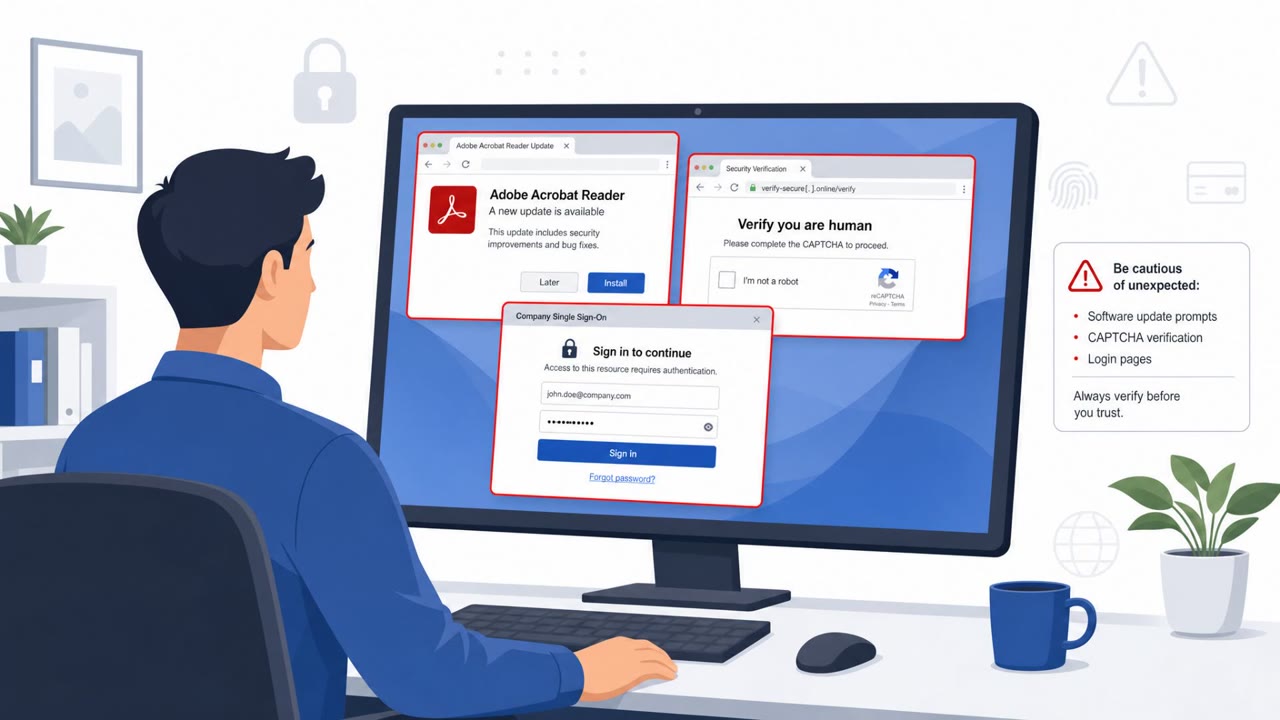
Cofense observed a real Black Friday-themed phishing campaign that used fake promotional offers to lure recipients into a multi-step verification process. The campaign routed victims through a fake offer page and an Adobe Acrobat lookalike before asking them to generate and submit a code, potentially giving attackers access to their Microsoft accounts.
How the Attack Worked
Cofense observed a real Black Friday phishing campaign that began with a German-language email subject line, "Black-Friday-Angebote, gültig ab Mittwoch" (Black Friday deals, valid from Wednesday). The email targeted business partners and customers with a supposed promotional offer and a link for more information. Clicking the link routed victims through a Constant Contact-hosted landing page, then to a fake Adobe Acrobat document-decryption page hosted on an Amazon AWS domain. From there, victims were sent to a page impersonating Microsoft identity verification, which instructed them to generate, copy, and submit a verification code.
Why It Succeeded
The attack layered multiple pretexts to build false legitimacy at each step. The initial email used a timely seasonal theme (Black Friday deals) to lower suspicion. The fake Adobe page displayed a loading animation to convince victims that a protected document was genuinely decrypting. By the time victims reached the verification code request, they had already clicked through several seemingly normal steps, making the final request feel like a routine continuation rather than a new action.
What to Watch For
Several warning signs were present throughout this campaign:
- The promotional offer page contained no merchant details or specifics about the deal itself.
- A shopping promotion unexpectedly required Microsoft identity verification, which has no legitimate connection to an offer.
- The apparent Adobe document page was hosted on an Amazon AWS domain instead of an Adobe domain.
- The final phishing page was hosted on a non-Microsoft domain despite impersonating a Microsoft verification process.
These mismatches between the claimed sender and the actual hosting domain are a recurring indicator across both stages of the attack.
How to Build Resistance
Organizations and individuals can reduce their exposure to this type of attack by reinforcing a few habits. Employees should confirm the authenticity of online promotions by checking a retailer's legitimate website directly rather than clicking email links. Verification codes should never be generated, copied, or submitted for an unexpected offer, file, or identity check, since this step can enable account takeover. Before interacting with any login page, file, or verification request, it is worth checking whether the website domain actually matches the company it claims to represent. Since this campaign targeted business partners, customers, and Microsoft 365 users across sales, procurement, and finance functions, awareness training should extend beyond IT staff to any employee who might receive a seasonal promotional email.
Key findings
- The observed campaign used a German-language Black Friday email subject: "Black-Friday-Angebote – gültig ab Mittwoch" (Black Friday deals – valid from Wednesday).
- The email targeted business partners and customers with a supposed promotional offer and directed them to a link for more information.
- Victims were sent from a Constant Contact-hosted landing page to a fake Adobe Acrobat document-decryption page hosted on an Amazon AWS domain.
- The final phishing page impersonated a Microsoft-related identity-verification process and instructed victims to generate, copy, and submit a verification code.
- The promotion contained no merchant details, and the verification process had no legitimate connection to a shopping offer, both are clear warning signs.
Who’s being targeted
- Commonly targeted roles: All employees, Sales and customer-facing teams, Procurement teams, Finance teams, Microsoft 365 users, Business partners.
- Affected industries: Cross-industry, Retail consumers, Businesses using Microsoft accounts.
- Attack channels: email, website.
- Impersonated: An unnamed Black Friday merchant or promotional sender; later Adobe Acrobat and Microsoft identity verification, Adobe Acrobat and Microsoft.
Red flags to watch for
- The offer page has no promotional details or merchant information.
- A shopping promotion unexpectedly requires Microsoft identity verification.
- The apparent Adobe document page is hosted on an Amazon AWS domain rather than an Adobe domain.
- The page uses a loading animation to create false legitimacy.
- The site domain is unrelated to Adobe or Microsoft.
- A promotional document should not require the recipient to generate and submit a verification code.
Frequently asked questions
How did the Black Friday phishing campaign steal Microsoft account access?
The campaign sent a German-language Black Friday promotional email that led victims through a fake Adobe Acrobat decryption page and then to a page impersonating Microsoft identity verification, where victims were asked to generate and submit a verification code that could give attackers account access.
What were the red flags in this phishing attack?
The offer page lacked merchant or promotional details, the identity verification request had no legitimate connection to a shopping promotion, and the fake Adobe page was hosted on an Amazon AWS domain rather than an Adobe domain.
Why is submitting a verification code dangerous?
Verification codes are often used in legitimate security processes, but attackers can trick victims into submitting one to gain unauthorized access to the victim's account, as described in this campaign.
Who was targeted by this phishing campaign?
The campaign targeted business partners, customers, and Microsoft 365 users across industries, including sales, procurement, and finance teams.
Read the video transcript
Black Friday deals, valid Wednesday? This email targets business partners. The link opens a Constant Contact offer page with no merchant details. Click 'Continue here to access your offer,' and an Adobe Acrobat lookalike on an Amazon AWS domain pretends to decrypt a PDF. Then comes the giveaway: a shopping offer asks for Microsoft identity verification. It tells you to generate a code, hit 'Code kopieren,' and paste it in. That's account access, not a discount. Don't copy that code. For the deal, open the merchant's real website yourself, not the email link.