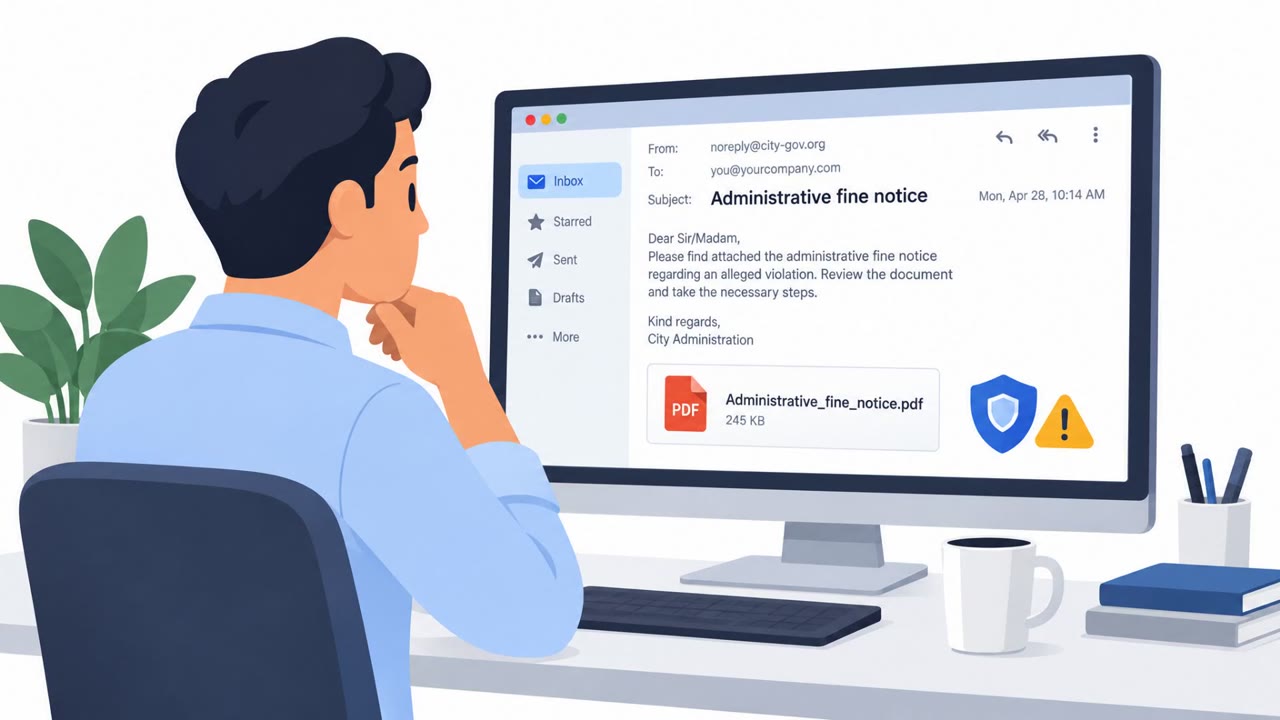
Blind Eagle is using Spanish- and Portuguese-language phishing emails that look like court, prosecutor, and administrative notices to target organizations in Latin America. The emails pressure people who handle legal or institutional requests to open an attachment, which ultimately installs remote-access malware. Researchers did not confirm successful compromises, but the campaign provides a clear, realistic phishing workflow for awareness training.
How the attack worked
Blind Eagle, also tracked as APT-C-36, sent phishing emails in Spanish and Portuguese designed to look like court notifications, fiscalía notices, tutela proceedings, and administrative documents. The messages targeted people who routinely deal with cases, contracts, judicial matters, or institutional service requests, pressuring them to open an attachment tied to an alleged legal or administrative proceeding.
One identified email used a Colombian judicial-themed XHTML file built as a weaponized SVG image. Opening it rendered a bogus web page impersonating Colombia's Fiscalía General de la Nación, the Office of the Attorney General. The page used HTML smuggling to assemble a ZIP archive locally in the victim's browser using ZipCrypto, a method that helps the payload slip past some email security controls because the archive never travels as a single file through the network.
Inside the ZIP was a JavaScript dropper disguised as “Network Configuration Auditor version 2.7.298.” Running it launched a Visual Basic Script that performed AMSI and ETW bypass steps while displaying a fake criminal-citation page as a distraction. The chain ultimately used PowerShell to decode and launch a remote-access trojan in memory.
Why it succeeded
The lure worked because it exploited the natural urgency people feel around legal and administrative matters. A message claiming to involve a court case, prosecutor's notice, or contract issue creates pressure to act quickly, especially for staff whose job is to respond to exactly these kinds of requests. The fake citation page added a layer of distraction, keeping the recipient's attention on a seemingly real document while the technical infection steps ran in the background.
What to watch for
- Unexpected court, fiscalía, or administrative notices arriving as XHTML, SVG, or ZIP attachments.
- A legal-looking attachment that opens as a web page instead of a standard document format.
- Any file suggesting it is security or networking software, such as a "Network Configuration Auditor."
- Messages creating urgency around a case, contract, or proceeding the recipient cannot independently verify.
How to build resistance
Organizations handling judicial, fiscal, administrative, or educational matters should treat unsolicited legal notices as high-risk until verified through a known official contact method or portal, never through links or attachments in the message itself. Staff should be trained not to open unexpected XHTML, SVG, ZIP, or script files tied to legal or contract claims, and to report any such attachment that opens a web page or prompts a download or execution. Because this targeting gives attackers access to sensitive legal, financial, and institutional information, extra verification procedures for staff in these roles can meaningfully reduce risk.
Key findings
- Blind Eagle, also known as APT-C-36, used judicial and administrative phishing lures in Portuguese and Spanish.
- The campaign targeted people handling cases, contracts, judicial matters, and institutional service requests.
- A Colombian judicial-themed XHTML/SVG attachment impersonated Colombia's Fiscalía General de la Nación.
- Opening the attachment caused the browser to assemble a ZIP file locally, bypassing some email security controls.
- The ZIP contained a JavaScript file disguised as “Network Configuration Auditor version 2.7.298,” which led to an AsyncRAT-related remote-access trojan.
- Researchers said there was no evidence of successful real-world compromises at the time of reporting.
Who’s being targeted
- Commonly targeted roles: Legal and case management teams, Contract and procurement staff, Judicial and public-administration employees, Institutional service-request teams, Education administration staff, Employees in Latin American organizations.
- Affected industries: Judicial organizations, Prosecutorial and fiscal authorities, Public administration, Educational organizations, Organizations handling legal cases and contracts.
- Attack channels: email, website.
- Impersonated: Colombia's Fiscalía General de la Nación (Office of the Attorney General).
Red flags to watch for
- An unexpected legal or prosecutor notice is sent as an unusual XHTML or SVG attachment.
- The sender creates urgency around a case, contract, or administrative proceeding that the recipient cannot independently verify.
- The attachment leads to a downloaded ZIP file or a file claiming to be “Network Configuration Auditor version 2.7.298.”
- A supposed court document opens as a web page rather than a normal official case-notice format.
- The page triggers or offers a ZIP download instead of directing the recipient to an established government portal.
- A legal notice results in a script or software-like file rather than a document.
Frequently asked questions
What is the Blind Eagle fake court notice campaign?
It is a phishing campaign by Blind Eagle, also known as APT-C-36, that uses Spanish and Portuguese emails resembling court, fiscalía, and administrative notices to trick recipients into opening malware-laced attachments.
How does the attachment infect a device?
A weaponized XHTML/SVG file renders a fake page impersonating Colombia's Fiscalía General de la Nación and uses HTML smuggling to assemble a ZIP archive locally in the browser, bypassing some email security controls. Inside the ZIP is a JavaScript dropper disguised as a software update that leads to a remote-access trojan.
Who is being targeted by this campaign?
The campaign targets people who handle cases, contracts, judicial matters, and institutional service requests, including legal, contract, judicial, and educational administration staff, mainly in Latin American organizations.
Were there confirmed victims of this campaign?
Researchers reported no evidence of successful real-world compromises at the time of reporting, though the techniques used are realistic and effective for training purposes.
Read the video transcript
A court notice lands in your inbox. But it’s an SVG attachment? Blind Eagle’s Spanish- and Portuguese-language emails impersonate Colombia’s Fiscalía General de la Nación. Open the attachment, and a fake prosecutor page appears while your browser builds a ZIP locally. That’s HTML smuggling: the ZIP is assembled after email scanning. Inside, 'Network Configuration Auditor version 2.7.298' is JavaScript, not a case document. Running it can lead to AsyncRAT. A legal notice shouldn’t install software. Got one? Verify it through the agency’s official portal, not the attachment.