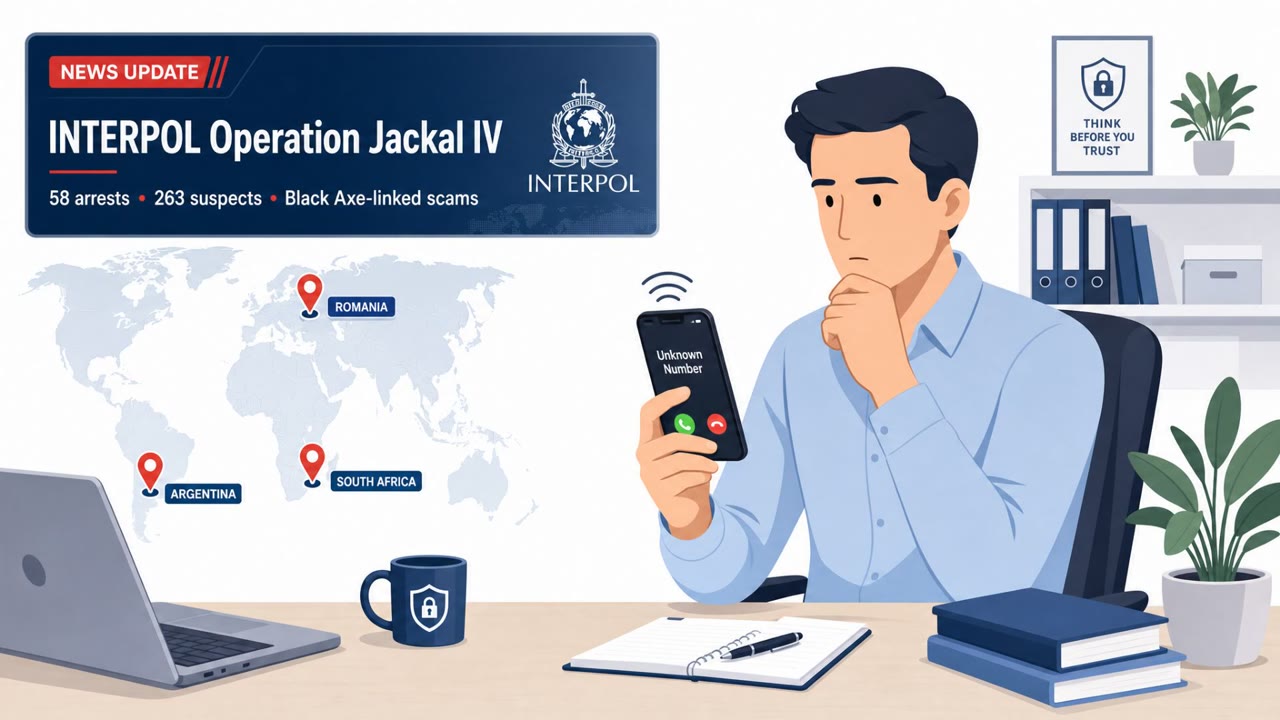
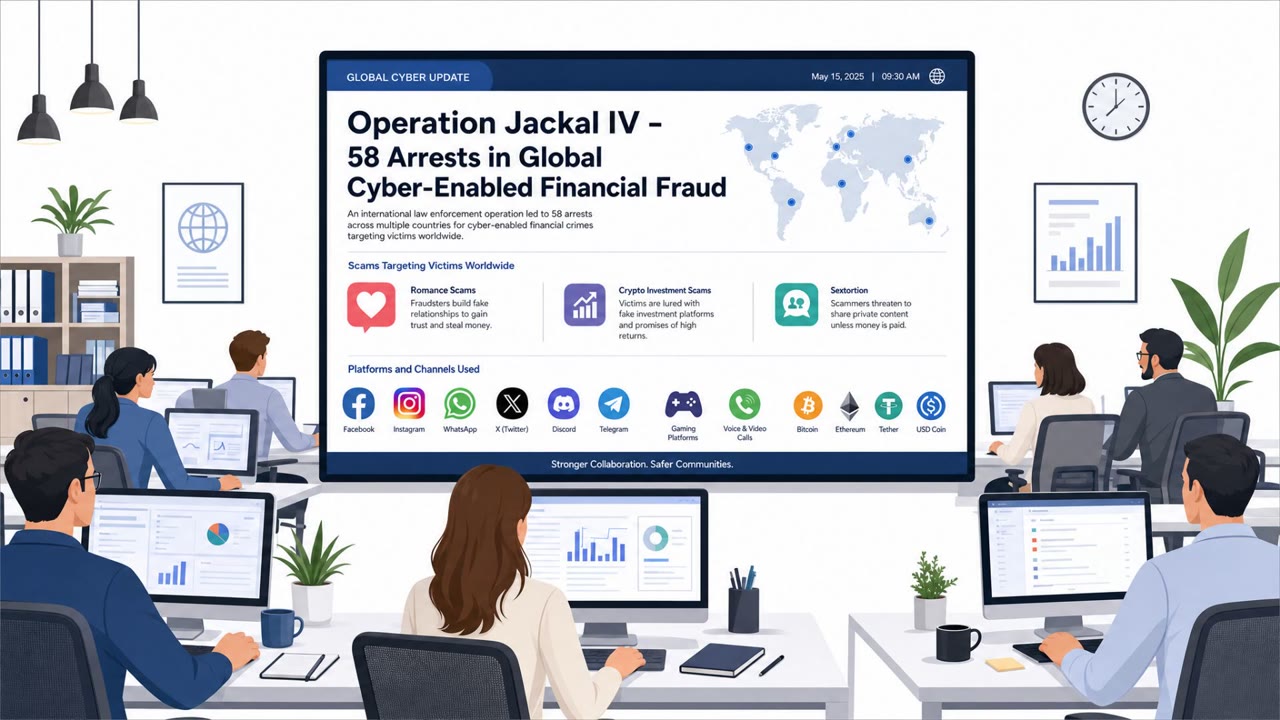
INTERPOL’s Operation Jackal IV (Nov 2025–Jun 2026) targeted the money-laundering backbone behind global online scams, leading to 58 arrests and 263 suspects linked to West African organized crime groups. Cases included romance/investment scams targeting retirees, a fake-investment call center tied to €143M in losses, and sextortion against minors where criminals built trust on social media and then demanded ransom.
What the operation uncovered
Operation Jackal IV, an INTERPOL-led effort running from November 2025 to June 2026, resulted in 58 arrests and identified 263 suspects tied to West African organized crime networks, including Black Axe. Rather than chasing individual scammers, investigators targeted the laundering infrastructure that keeps these operations running: shell companies, mule accounts, and remittance services that move and hide stolen funds.
How the schemes worked
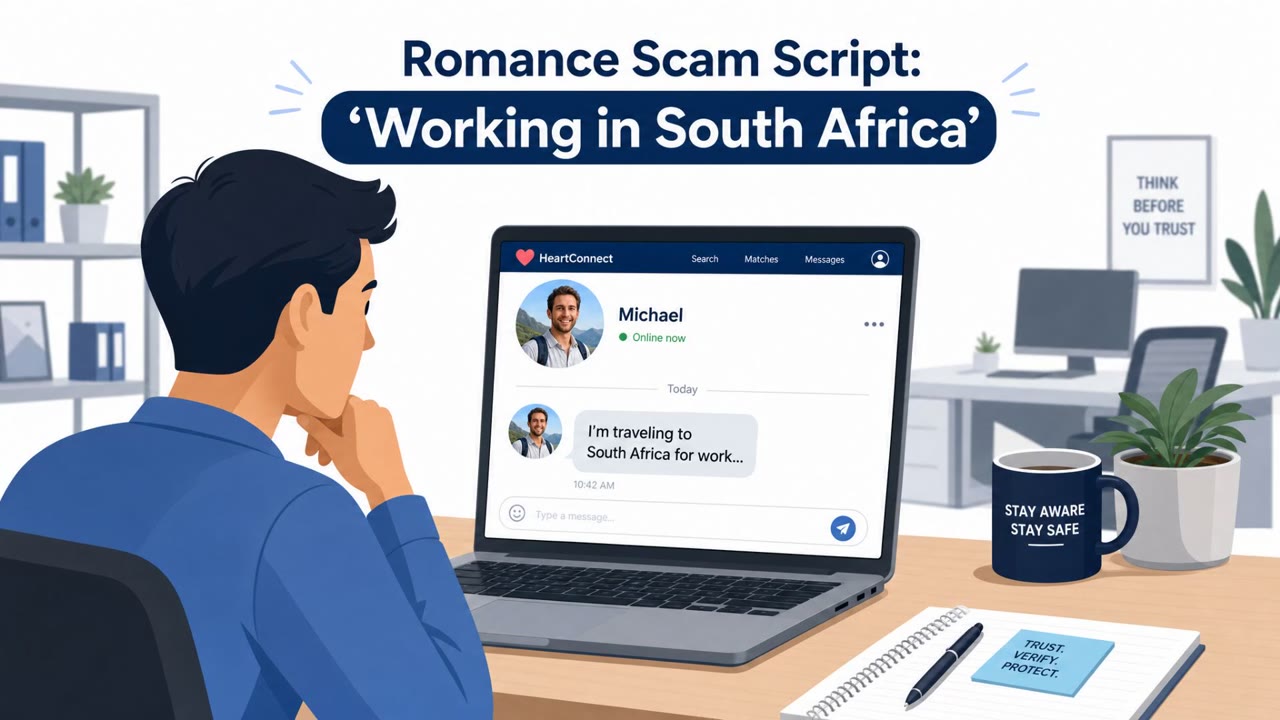
The operation surfaced several distinct fraud patterns. In South Africa, a group ran romance and investment scams against retirees, using specialized roles such as "conversion" and "retention" agents to manage victims over time. In Romania, a call center dismantled by authorities was running a fake investment scheme promising big returns on stocks and crypto, funneling victims' money into wallets the operators controlled. Losses and laundering tied to that operation reached an estimated €143 million globally. Separately, INTERPOL flagged a rise in sextortion targeting minors, where offenders build trust on social media before coercing victims into sharing explicit content and then threatening to distribute it unless a ransom is paid.
Why these schemes succeeded
These scams succeeded because they combined believable pretexts with organizational structure. Fraudulent investment pitches promised guaranteed high returns, a hook that overrides normal caution, especially when reinforced by persistent follow-up from staff playing dedicated "conversion" and "retention" roles. Sextortion cases relied on the gradual trust-building common to normal social media interactions before pivoting to coercion, making the shift hard for victims to recognize in time. In both cases, the laundering side, fragmented transactions moving through many accounts, made the financial trail harder to trace and stop early.
What to watch for
- Unsolicited offers promising unusually high or guaranteed investment returns
- Pressure to move money quickly into a wallet or account controlled by the other party
- Online contacts who escalate rapidly toward private, sexual, or financially sensitive requests
- Persistent, professional-sounding follow-up calls or messages pushing a financial decision
Building resistance
Organizations and families can reduce exposure by treating unsolicited investment offers as suspect by default and verifying any provider independently before sending funds. Employees and family members, especially those supporting minors, benefit from awareness of sextortion patterns: rapid trust-building followed by coercion and threats. Financial teams should reinforce stop-and-verify steps for unusual transfer requests, since these laundering networks depend on moving money through many small, fragmented transactions across mule accounts.
Key findings
- Operation Jackal IV (Nov 2025–Jun 2026) resulted in 58 arrests and identified 263 suspects tied to West African organized crime networks (including Black Axe).
- Investigators focused on disrupting laundering infrastructure (shell companies, mule accounts, remittance services) rather than only individual scammers.
- South Africa raided a group running romance and investment scams against retirees; the group used specialized roles like “conversion” and “retention” agents.
- Romania dismantled a call center running a fake investment scheme promising big returns on stocks and crypto; estimated losses/laundering reached ~€143M globally.
- INTERPOL reported a rise in sextortion targeting minors: offenders contact victims via social media, build trust, coerce explicit content, then threaten distribution unless a ransom is paid.
Who’s being targeted
- Commonly targeted roles: Finance/AP and Treasury, Executives, All employees (general awareness), Customer support/fraud teams, Parents/guardians (community outreach where applicable).
- Affected industries: Financial services (payments, remittance, banking), General public/consumers, Social media platforms.
- Attack channels: website, vishing.
- Impersonated: Investment brokerage / crypto investment firm (fraudulent), Investment advisor / account manager (fraudulent call center), Peer/romantic interest met via social media (fake persona).
Red flags to watch for
- Promises of unusually high or guaranteed returns
- Pressure to transfer funds quickly to a wallet/account you control
- Unverifiable firm identity or vague licensing details
- Unsolicited call offering investment returns
- Requests to move money into crypto wallets controlled by the ‘advisor’
- High-pressure tactics and refusal to provide written documentation
- Rapid escalation to private chat and sexual content
- Threats to send content to contacts unless paid
- Requests for secrecy and immediate payment
Frequently asked questions
What was Operation Jackal IV?
Operation Jackal IV was an INTERPOL operation running from November 2025 to June 2026 that targeted the money laundering infrastructure behind global online scams, resulting in 58 arrests and 263 identified suspects linked to West African organized crime networks.
What kinds of scams were involved?
Cases included romance and investment scams targeting retirees, a fake investment call center tied to roughly €143 million in losses, and sextortion schemes against minors where offenders built trust on social media before demanding ransom.
How did investigators approach the laundering networks?
Investigators focused on disrupting the laundering infrastructure itself, including shell companies, mule accounts, and remittance services, rather than only pursuing individual scammers.
What red flags should people watch for?
Key red flags include unsolicited investment offers promising unusually high returns, pressure to send money to a crypto wallet or account, and online contacts who quickly escalate to requests for explicit content or urgent payment demands.
Read the video transcript
INTERPOL just busted a fake investment network that laundered about €143 million through call centers and bogus crypto sites. Here’s how it worked: a polished “advisor” calls or a slick site pops up saying, “You’ve been selected for an investment opportunity promising big returns on stocks and crypto.” Your money goes straight into wallets they control. These aren’t random one-offs. INTERPOL’s Operation Jackal IV found organized groups with 'conversion' and 'retention' agents trained to keep you talking and keep you paying, including romance and sextortion scams targeting families. If anyone contacts you out of the blue with 'guaranteed' stock or crypto returns, hang up, close the site, and only invest through providers you look up yourself.