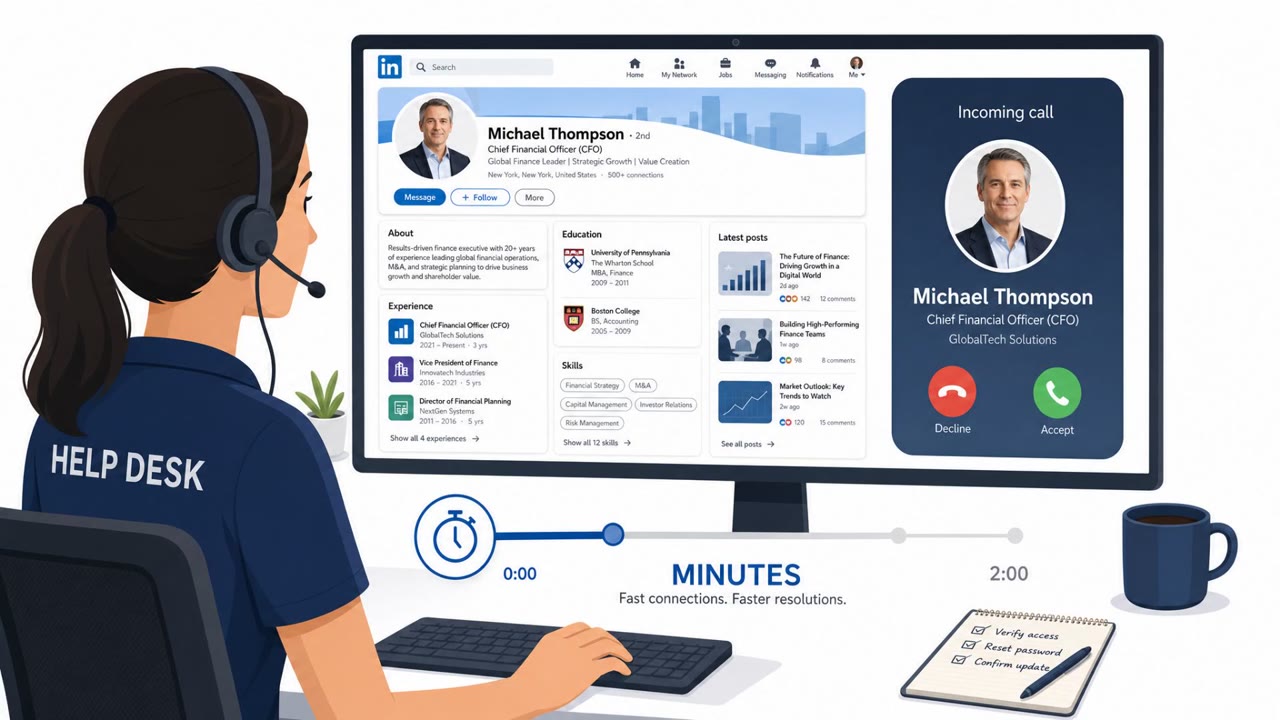
This article describes the reported social-engineering attack that led to the 2023 MGM Resorts breach. Attackers allegedly impersonated an employee in a phone call to the IT help desk and persuaded staff to reset the employee’s password and MFA, showing why account-recovery processes need strong identity checks.
How the attack reportedly worked
According to the article, the 2023 MGM Resorts breach began with a phone call to the IT help desk. The caller impersonated an employee and persuaded help desk staff to reset that employee's password and MFA enrollment. This gave the attacker a path into the account without needing to break any cryptographic control or guess a credential. The article identifies Scattered Spider as the group behind the MGM attack, citing a joint FBI and CISA advisory.
Why this approach succeeded
The attack did not target the login process directly. It targeted the account-recovery workflow instead, which the article describes as typically weaker than the authentication it is meant to back up. A help desk agent under pressure to resolve a locked-out employee's problem quickly may not apply the same scrutiny that a login system would. Resetting both a password and MFA in a single request is especially risky because it hands the caller broad access to the account at once.
What defenders should watch for
Key red flags in this type of call include:
- A caller whose identity cannot be verified through an approved, independent process
- Pressure on the help desk to bypass normal recovery steps or move quickly
- A request to reset both a password and an MFA method in the same call, which expands access beyond what a routine reset would provide
These patterns apply broadly to any organization with an IT help desk and a recovery process, not just hospitality and gaming environments.
Building resistance in recovery workflows
The awareness takeaways in the source material point to a few practical steps for IT help desk, service desk, and identity and access management teams:
- Require approved, independent identity verification before any password, MFA, or recovery setting change
- Treat combined password and MFA reset requests as high-risk and route them to stronger review or escalation
- Train service desk staff that a caller who sounds convincing, or who appears to know employee details, may still be an impersonator
The article frames this as a recovery problem rather than a login problem. Strengthening the verification steps around account recovery, not just the authentication method itself, is what closes the gap that this kind of call is designed to exploit.
Key findings
- The article says the 2023 MGM Resorts breach reportedly began with a phone call to the IT help desk.
- The described playbook was to impersonate an employee and persuade the help desk to reset that employee’s password and MFA.
- The article identifies Scattered Spider as the group behind the MGM attack, citing a joint FBI and CISA advisory.
- Recovery and help-desk workflows can undermine otherwise strong authentication controls when identity verification is weak.
Who’s being targeted
- Commonly targeted roles: IT Help Desk, Service Desk, Identity and Access Management teams, Security Operations, Employees responsible for account recovery and MFA administration.
- Affected industries: Hospitality and gaming, Organizations with IT help desks and account-recovery processes.
- Attack channels: vishing.
- Impersonated: Employee of the organization.
Red flags to watch for
- The caller’s identity cannot be verified through an approved, independent process.
- The caller pressures the help desk to bypass normal recovery controls.
- The request involves resetting both a password and MFA, which would give the caller broad account access.
Frequently asked questions
How did the reported MGM Resorts breach start?
The article says it reportedly began with a phone call to the IT help desk in which attackers impersonated an employee to get a password and MFA reset.
Who is identified as responsible for the MGM attack?
The article identifies Scattered Spider as the group behind the MGM attack, citing a joint FBI and CISA advisory.
Why are help desk resets a weak point even with strong MFA?
Recovery and help desk workflows can undermine otherwise strong authentication controls when identity verification during a reset request is weak.
What should help desk staff watch for in these calls?
Red flags include an unverifiable caller identity, pressure to bypass normal recovery controls, and requests to reset both a password and MFA at once.
Read the video transcript
The MGM Resorts breach reportedly started with a help-desk call. The caller posed as an employee: ‘I’m locked out. I need my password and MFA reset.’ The help desk was reportedly persuaded to change both. That’s the aha: Scattered Spider didn’t need to beat MFA at login. According to the report, the reset process let them go around it. If someone asks for both resets, verify their identity through your approved, independent process before changing either.