Okta says a threat cluster possibly linked to ShinyHunters is still targeting organizations under the Inception name. The group uses voice phishing to persuade employees to enter credentials on phishing pages and approve MFA prompts, then steals data for extortion.
How the attack worked
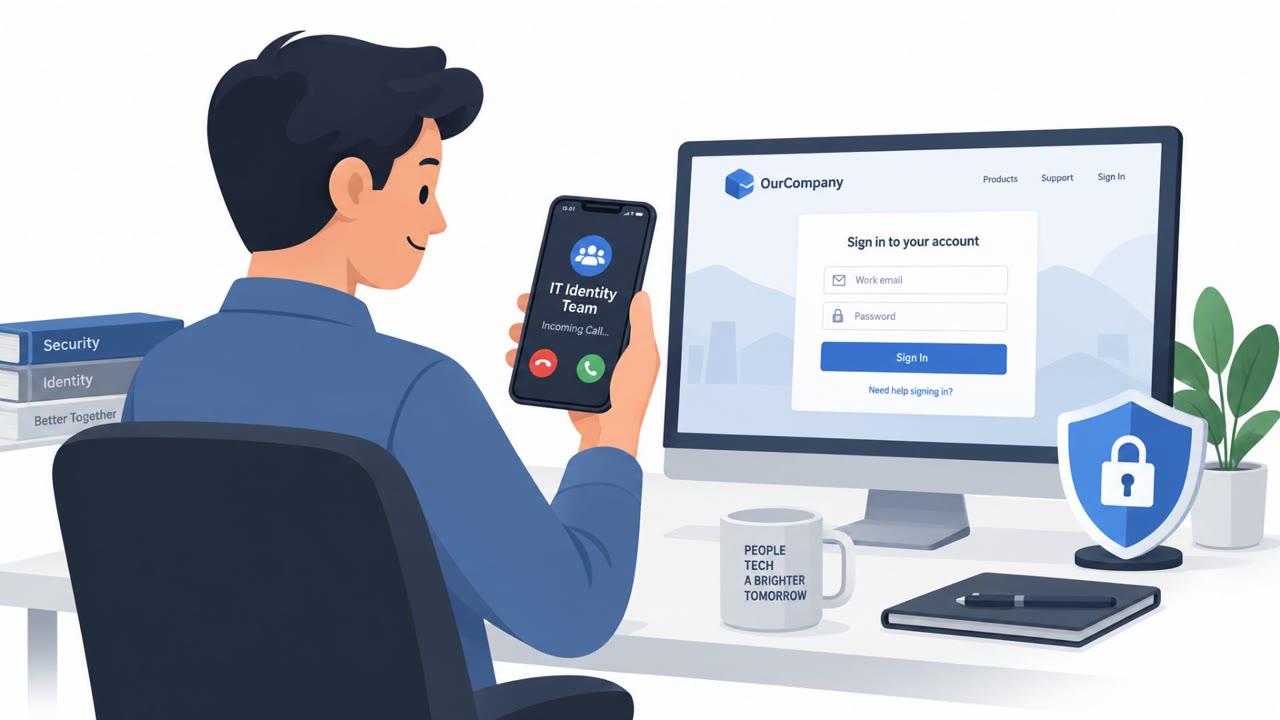
According to Okta, a threat cluster it tracks as O-UNC-053 has rebranded itself as Inception but continues to run the same type of operation. The core technique is voice phishing: a caller contacts an employee and talks them into visiting a lookalike sign-in page, entering their company credentials, and then approving a multi-factor authentication prompt. Once the attacker has both the credentials and the MFA approval, they can take over the account, access company systems, and steal data that is later used for extortion.
Okta's researchers observed infrastructure being registered six to 19 days before Inception listed alleged victims on its leak site, suggesting a pattern of preparation before organizations are named publicly. Seven organizations were listed as claimed victims, though none had confirmed a breach at the time of reporting, and Okta said it could not validate whether the data the group claimed to have published was authentic.
Why it succeeded
This style of attack succeeds because it combines a live human conversation with a request that looks routine: signing in and approving an MFA prompt. Employees are often trained to be cautious about suspicious links in email, but a phone call that sounds like IT support or a help desk can carry a false sense of legitimacy. The combination of credential entry and an MFA approval request in the same interaction is what gives the attacker working access, not just a stolen password.
What to watch for
- An unsolicited caller who directs you to a sign-in page you were not expecting.
- Pressure to approve an MFA request that you did not initiate yourself.
- A request that bundles entering credentials with approving a second-factor prompt in the same conversation.
These red flags apply broadly across roles, since the targeting described includes all employees, help desk and IT support staff, identity and access management teams, finance and payroll staff, and executives.
How to build resistance
Organizations can reduce exposure to this pattern with a few concrete steps:
- Treat any unexpected MFA approval request as a possible account-takeover attempt, particularly when it arrives during a phone call.
- Instruct employees to end suspicious calls and verify the request through a known, independently obtained company contact method rather than a number or link provided by the caller.
- Move toward phishing-resistant MFA methods where feasible, since they are harder for a voice-phishing caller to bypass with a simple approval prompt.
- Extend awareness training beyond technical staff, since the group has targeted organizations across industries including semiconductors, healthcare, payroll and HR services, and automotive retail.
This technique maps to MITRE ATT&CK T1566.004 (Spearphishing Voice) and T1621 (Multi-Factor Authentication Request Generation), both of which describe the mechanics seen in this activity.
Key findings
- Okta tracks the activity as O-UNC-053 and says the operators appear to have changed branding to Inception.
- The attackers use voice phishing to trick people into submitting credentials on phishing pages and approving MFA requests.
- Okta observed infrastructure registrations six to 19 days before Inception listed alleged victims on its leak site.
- Seven organizations were listed as claimed victims, but none had confirmed a breach when the article was published.
- Okta could not validate that the data allegedly published by Inception was authentic.
Who’s being targeted
- Commonly targeted roles: All employees, Help desk and IT support staff, Identity and access management teams, Finance and payroll staff, Executives and executive assistants, Employees with access to sensitive data.
- Affected industries: Semiconductors, Healthcare, Payroll and HR services, Food and beverage, Medical products distribution, Automotive retail, Electric vehicle technology.
- Attack channels: vishing, website.
- Impersonated: Not specified; the article describes scammers conducting voice phishing..
Red flags to watch for
- An unsolicited caller directs the employee to a sign-in page.
- The caller pressures the employee to approve an MFA request they did not initiate.
- The request combines credential entry with an unexpected MFA approval.
Frequently asked questions
Is Inception the same group as ShinyHunters?
Okta has not formally confirmed that O-UNC-053, now branded Inception, is the same crew as ShinyHunters, but researchers note it uses nearly identical social engineering tactics.
How does the Inception voice phishing attack work?
Callers persuade employees to enter their credentials on a phishing page and then approve an MFA request, giving attackers account access they use for data theft and extortion.
Which organizations were affected?
Seven organizations were listed as claimed victims on Inception's leak site, though none had confirmed a breach at the time of reporting and Okta could not validate the authenticity of the published data.
How can organizations reduce the risk of this attack?
Awareness takeaways include refusing to approve unsolicited MFA requests, verifying callers through known contact methods, and adopting phishing-resistant MFA.
Read the video transcript
Your phone rings. The caller says, ‘Sign in on this page and approve MFA.’ That’s voice phishing. Okta tracks this activity as O-UNC-053, now using the Inception name. The caller sends you to a phishing page for your company password. Then comes the MFA prompt. Here’s the giveaway: the caller wants you to approve a sign-in you didn’t start. That approval could give them your account. If a caller asks for a sign-in or MFA approval, hang up and call your company help desk using its saved number.